

Читать: 5334 слов, ~21 минуты
Социальная наука будущего может быть настолько же онтологически удивительной, как физика 20-го века
Дон Росс
Актуальность исследования
Цель диссертации: натуралистическое объяснение возникновения принудительной силы эпистемических конструкций (правил) в онтологии институтов.
Социальные институты — деньги, собственность, брак и другие — обладают принудительной силой из-за наших представлений о них. Коллективное представление «эта бумага — деньги» не описывает мир, но активно его формирует, наделяя бумагу причинной силой и способностью к ценностному обмену, а математическая модель оценки опционов, распространяясь среди трейдеров, становится для них руководством к действию, и реальные цены опционов начинают соответствовать предсказаниями модели (MacKenzie, 2006).
Подобные «онтологические эффекты» — способность эпистемических конструкций людей оказывать причинное и принуждающее воздействие на их поведение — одна из центральных и наиболее сложных проблем социальной онтологии. Внутри философии социальной науки это проблема отношения конструктивизма и реализма — вопроса о том, существуют ли социальные сущности объективно и отдельно от сознаний людей или же полностью зависят от последних (Guala, 2016a; Hacking, 1999). А проблема конструктивизма/реализма — частный случай проблемы соотношения реализма и антиреализма в философии науки — вопроса о том, существуют ли ненаблюдаемые сущности вроде квантовых полей, генов и атомов объективно, или же служат удобными фикциями (Samir Okasha, 2002).
Джон Сёрл (J. Searle, 1995) одним из первых сформулировал проблему онтологического статуса социальных фактов и институтов: как можно быть эпистемологически объективным касательно онтологически субъективных вещей? Сёрл показал, что социальные (или, как он их называет, институциональные) факты создаются конститутивными правилами вида «X считается Y в контексте C». Эти правила зависят от коллективного признания (collective acceptance) и имеют принудительную силу1. Коллективное признание зависит от коллективной интенциональности (we-intentionality) — постулируемой Сёрлом когнитивной способности индивидов иметь сонаправленность мысли.
Принудительная сила и каузальность конститутивных правил исходят из их «деонтических сил» — создаваемых конститутивными правилами прав, обязанностей, полномочий, разрешений, требований и запретов. Например, факт «Этот человек — судья» наделяет его деонтической силой: правом выносить приговор, обязанностью соблюдать процедуру, полномочиями требовать показания. Эти полномочия имеют причинную силу, потому что мотивируют поведение. Люди признают эти полномочия и действуют в соответствии с ними, а также требуют их признания от других. Сёрл подчеркивает, что деонтические силы создают мотивы для действия, которые не зависят от личных желаний. Люди платят налоги не потому, что сами хотят, а потому, что есть обязанность их платить, вытекающая из статуса гражданина/налогоплательщика. Каузальная сила конститутивного правила — это способность статусной функции (Y), присвоенной объекту (X) коллективным признанием людей, мотивировать их поведение через систему деонтических сил.
Однако теория Сёрла часто подевргалась критике: из-за недостаточности деонтических сил для объяснения следования правилам (Guala & Hindriks, 2015), отсутствия механизма возникновения конститутивных правил и каузальности деонтических сил [#insertSource], переоценки роли рационального коллективного признания и «сверхинтеллектуализма» (Gilbert, 1992) и других. Помимо критики внутри философии и социальной онтологии, теория Сёрла подвергалась критике в философии социальной науки — особенно за постулирование примата социальной онтологии над методологией изучения социальной реальности (Kincaid, 2021; Lauer, 2019; Little, 2020; Ross, 2023). Философ Дон Росс различил аналитическую и научную (натуралистическую) социальную онтологию и показал, что только последняя может
Будучи зависящей от понятия коллективных представлений и коллективной интенциональности, теория Сёрла не объясняет их строение и возникновение. Подобную натурализацию его проекта продолжают философы, близкие к эволюционной теории (Gallotti, 2012; Gallotti & Frith, 2013; Tomasello, 2014) и теории «совместного действия» (joint action) в когнитивной науке (Paternotte, 2020a; Sebanz & Knoblich, 2021; Török, Pomiechowska, Csibra, & Sebanz, 2019; Vesper et al., 2017). Одна из основных проблем в этом поле — вопрос производности совместной интенциональности от индивидуальной (I-mode vs. we-mode).
Несмотря на большое влияние в социальной онтологии и за её пределами, теория Сёрла — не единственная, что объясняет принудительную силу институтов. Теория игр и её применение к изучению социальных конвенций — настолько же влиятельный подход к объяснению.
Франческо Гуала (Guala, 2016a), синтезурует Льюиса и Серля в теорию правил-в-равновесии (rules-in-equilibria, ПвР). Она описывает социальные институты как равновесные состояния, коррелируемые2 регулятивными правилами вида «если X, делай Y». Например, правило «зелёный свет — иди, красный — стой» коррелирует выбор стратегий между пешеходами и автомобилистами, у каждого из которых есть две условных стратегии — «если красный — стой» и «если зелёный — двигайся». В теории Гуалы, конститутивные правила эпифеноменальны по отношению к регулятивным: между ними нет онтологической разницы, и последние можно описать как первые с помощью простой трансформацией: к паттернам поведения, описываемым регулятивными правилами, добавляется институциональный термин, например, «дорожное движение» (Guala & Hindriks, 2015; Frank Hindriks, 2005).
Так теория ПвР связывает онтологию Сёрла с научными подходами из теории игр без метафизических конструктов вроде конститутивных правил и коллективной интенциональности.
Однако теории Гуалы объясняет только стабильность социальных фактов, а не их возникновение. Мотивируя ПвР, Гуала исходит из недостаточности обоих подходов по отдельности — социальных фактов как правил (J. Searle, 1995) и социальных фактов как равновесий в стратегических играх (Aoki, 2007; North, 1990): первые могут не обладать каузальной силой, а вторые не схватывают специфически человеческих форм координации, поскольку применимы и к животным.
Логичным становится вопрос — если координация людей и животных описывается схожими формальными моделями, откуда и почему возникают правила, стабилизирующие эти равновесия у людей?
Ключ к решению этой проблемы лежит в анализе эволюции устройств корреляции — того, с помощью чего агенты в стратегическом взаимодействии координируют свои действия. Чтобы прояснить, рассмотрим два примера.
Два самца бабочки разрешают конфликт за территорию, координируя поведение на простом физическом сигнале — «кто первым занял место» (Davies, 1978). Их стратегия условна (conditional) и зависит от наблюдаемых признаков среды — наличия или отсутствия оппонента на территории. У каждой бабочки есть две стратегии поведения:
- если я хозяин — борюсь насмерть
- если я захватчик, проявлю агрессию, но если не сработает, отступлю.
Теперь взглянем на людей. Два человеческих племени, разделённые высохшим руслом реки, продолжают соблюдать границу, которая стала абстрактной (Guala & Hindriks, 2015).
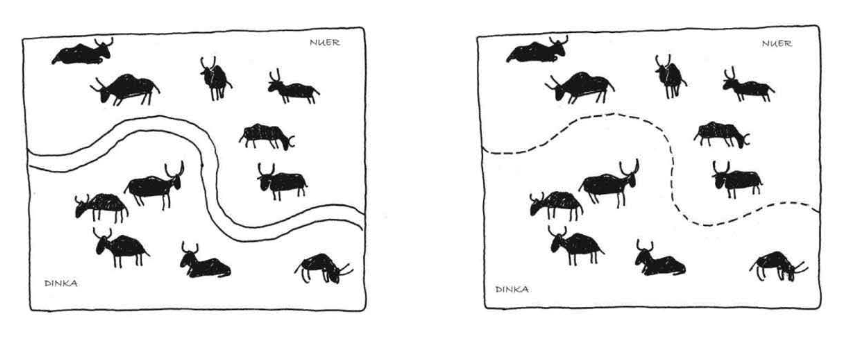
Их стратегия также условна, но зависит уже не от физического маркера — высохшего русла реки, а от разделяемого правила — «Если земля находится к югу (или к северу — для другого племени) от русла реки, пасти скот». Хотя эта стратегия связана с высохшим руслом, в ней это русло важно не само по себе, а как средство кодирования информации. Высохшее русло поддерживает (scaffolds) более глубокую эпистемическую структуру, основанную на общем знании (или общей причине полагать) (Lewis, 2008) о том, что это высохшее русло означает. Агенты координируют действия на разделяемом убеждении, а не на физическом маркере. Это устройство корреляции, абстрагированное от физического маркера с помощью когнитивной репрезентации разделяемого правила.
Люди, в отличие от бабочек, могут выбирать, на чем координировать свои действия (Guala & Hindriks, 2015). Это делает природу этих равновесных состояний разной, однако Гуала не объясняет причину этой разницы.
С точки зрения теории игр эти ситуации идентичны. Для их описания подходит одна и та же матрица выигрышей.
Онтологически между ними принципиальная разница: в первом случае координация следует за физической асимметрией среды (кто первым занял место), во втором — за эпистемической структурой разделяемого правила (чья территория, и как высохшее русло дает это понять).
Идентичные матрицы не схватывают разницу в моделях Гуалы и не отвечают на вопрос — если у животных уже есть стабильные равновесия, как и зачем возникают правила? А главное — в чём эволюционное преимущество правил как коррелирующих устройств, если они не влияют на равновесие?
Как пишет Брайан Скирмс, позитивная корреляция стратегий с самими собой — как в обоих примерах с условной стратегией выше — способствуют развитию кооперации и эффективности: «эволюционная динамика реализует дарвиновскую версию категорического императива Канта: поступай так, чтобы если другие ведут себя так же, приспособленность к среде была максимальной» (Skyrms, 2014a, p. 62).
Однако это по-прежнему не объясняет возникновение институциональных фактов из физических: почему в обоих случая есть равновесия, но их онтология разная? Как эволюционно могли возникнуть правила-в-равновесии, если равновесия уже существуют в координации животных?
В данной работе мы утверждаем, что эта разница преодолевается через анализ того, что теоретико-игровые модели принимают как данность и не учитывают в своих моделях — устройств корреляции. Это то, с помощью чего агенты координируют свои стратегии поведения — кто первым занял место в примере бабочек и территориальное правило в примере про племена.
Инструменты теории игр агностичны к природе устройства корреляции — они просто предполагают, что они есть (Vanderschraaf, 1995). Однако если рассмотреть формулы теории игр не инструментально, — агностично к их референтам в мире — а онтологически — как имеющие референты в мире, мы увидим разрыв именно в природе устройств корреляции.
В данной работе мы утверждаем, что этот разрыв можно преодолеть с помощью экологического механизма когнитивной эволюции.
Если равновесные состояния отражают реальные состояния мира — состояния популяций животных и людей и их физических сред, то устройства корреляции — это реальные объекты. Проблема теперь заключается в том, как устройства корреляции стали абстрактными, перейдя от физических свойств среды вроде «размера оппонента» или «очередности» к эпистемическим конструкциям — разделяемым правилам с нормативной и каузальной силой. Оба типа устройств корреляции реальны и обладают каузальной силой. Однако один из них — физический, а второй — эпистемический. И эволюционный переход между ними возможен благодаря экологической динамике.
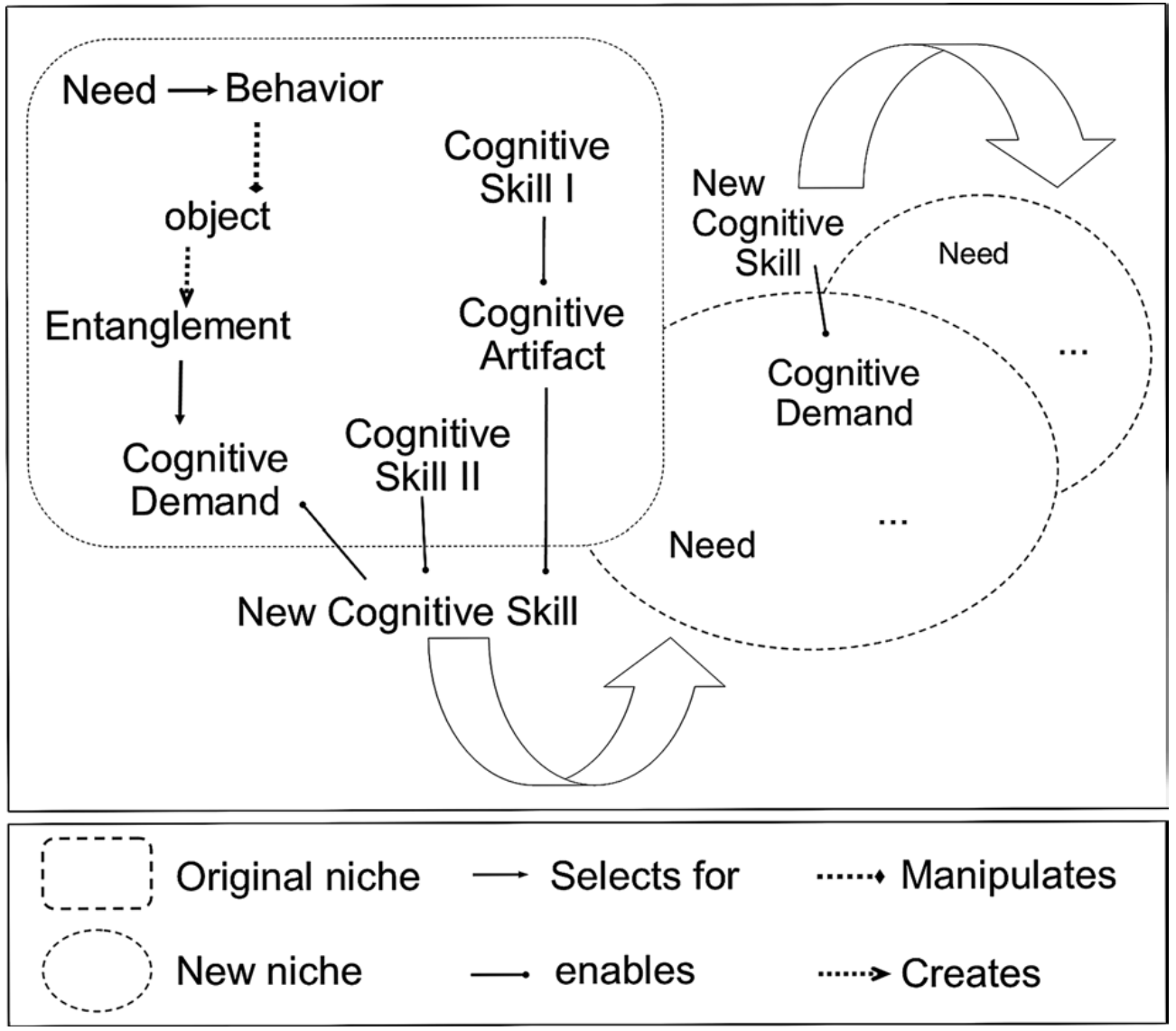
Переход от простых сигналов среды вроде «уже занятого места» к репрезентируемым правилам представляет собой коэволюционный процесс, в котором материальные артефакты кодируют информацию и выступают когнитивными опорами (scaffolds), а возникающие правила приобретают каузальную силу через свою адаптивную функцию в среде — координировать действия для достижения целей выживания (Harms, 2004; millikan1984?). Социальное конструирование и правила в ПвР возникают как постепенное усложнение корреляционных механизмов под давлением дарвиновского отбора, а их реальность оказывается производной от их стабильной каузальной роли в системе «агент-среда».
Как мы будем утверждать вслед за Кимом Стерельны (Sterelny, 2003) и Питером Годфри-Смитом (Godfrey-Smith, n.d.; Planer & Godfrey‐Smith, 2021), растущая информационная сложность среды эволюционно создавала давление отбора на агентов, вынуждая их развивать когнитивные способности для представления более абстрактных характеристик среды, поскольку это влияло на их способность к успешному решению проблем координации, от которого во многом зависело выживание. С помощью таких абстрактных репрезентаций и давления, создаваемого ими, появлялись новые способы координации, которые и привели к появлению объективности и обязательности социальных фактов.
Данная работа занимает сторону научной социальной онтологии (Ross, 2023), которая исходит не из априорных концептов, а из логики вывода к наилучшему объяснению (IBE) (Guala, 2016b). Онтология служит не предпосылкой, как в аналитическом подходе, а результатом исследования, выводясь из теорий, которые наилучшим образом объясняют наблюдаемые феномены.
Мы предлагаем механистический взгляд на возникновение каузальности социальных фактов из простых стратегических взаимодействий животных с их средой:
- Агенты без способности к репрезентации взаимодействуют друг с другом в популяциях и координируют поведение на физических маркерах вроде «размер оппонента»
- Со временем взаимодействие агентов оставляют следы в окружающей среде
- Следы создают новую информационную структуру среды, которая делает существующие способы координации неэффективными
- Возникает эволюционное давление на когнитивное усложнение агентов для распознавания новых сигналов как устройств корреляции
- Благодаря рекурсивной динамике, агенты постепенно развивают способность ко всё более абстрактному представлению следов среды, что в итоге позволяет им координировать поведение на основе разделяемых представлений.
Мы покажем, как этот экологический механизм завершает картину, предложенную Сёрлом и Гуалой: Сёрл описал онтологию социальных фактов, Гуала — их натуралистическую структуру, а настоящая работа объясняет их естественное возникновение из несоциальных взаимодействий.
Теоретически результаты могут быть интересны исследователям в области философии науки, социальной онтологии, когнитивной науки и теории эволюции. Результаты исследования также могут быть использованы в качестве материалов для курсов по философии социальных наук и социальной онтологии.
🚧 Объект и предмет исследования
Объект диссертационного исследования — онтология социальных институтов.
Предмет исследования — разделяемые агентами репрезентации как источник принудительной (нормативной) силы социальных институтов.
Степень разработанности проблемы
Наш проект носит междисциплинарный характер: он сочетает социальную онтологию, эволюционную теорию игр и философию биологии. Он направлен на то, чтобы внести вклад в натурализацию социальной нормативности, то есть объяснение нормативных феноменов как возникающих в результате естественных процессов без метафизических или интерпретационных представлений. Это согласуется с научно-реалистической перспективой, которая рассматривает социальные виды как реальные сущности, обладающие причинно-следственной связью, поддающиеся эмпирическому исследованию и индуктивному выводу (Guala, 2016b; boyd1999?).
Диссертация отталкивается от классической теории Джона Сёрла и её переосмысления в теории правил-в-равновесии Франческо Гуалы, которая предлагает единую основу для понимания социальных институтов как «коррелированных равновесий» (КР), поддерживаемых условными стратегиями агентов (Guala & Hindriks, 2015). Однако теория Гуалы, несмотря на свою концептуальную силу, во-первых, редуцирует конститутивные правила и социальную казуальность до понятия «социального института», а во-вторых не говорит, как равновесия и лежащие в их основе условные стратегии развиваются из простых форм координации, наблюдаемых у животных, в более сложные. Для устранения этого пробела необходимо объединить идеи эволюционной теории игр и философии биологии, касающиеся когнитивной эволюции, чтобы проследить эволюционное возникновение эпистемической агентности, опосредованной убеждениями.
Настоящая диссертация развивает проект Гуалы, явно моделируя эволюционный путь от координации на основе простых физических сигналов к возникновению несвязанных, подобных убеждениям представлений правил, в соответствии с которыми действуют агенты. Опираясь на теорию игр (Skyrms, 1994, 2010a) и философию биологии (Godfrey-Smith, 2002; Planer & Godfrey‐Smith, 2021; Seitz, 2020; Sterelny, 2003, 2012a, 2021) в диссертации показано, как агенты эволюционируют, чтобы выводить скрытую структуру своей среды, вырабатывать расцепленные (decoupled) репрезентации и, в конечном итоге, координировать действия на основе общих нормативных правил. Этот подход подтверждает утверждение Гуалы о том, что правила являются когнитивными представлениями о равновесии, но, демонстрирует, как такие представления могут развиваться из ненормативных источников, а не предполагаться или навязываться внешними корреляционными механизмами.
Кроме того диссертация отвечает на критику теории Гуалы о том, что она чрезмерно экстерналистская (Roversi, 2021) или недостаточно учитывает материальную и психологическую реальность институтов (Rabinowicz, 2018).
Начиная с основополагающих моделей координации Дэвида Льюиса (Lewis, 2008), Брайана Скирмса (Skyrms, 1994, 2010a) и других, и расширяя исследование теоретико-игровой социальной онтологии Гуалы, анализ приводит к проведению принципиального различия между онтической корреляцией стратегий — когда физические маркеры среды становятся источником сигнала, и эпистемической корреляцией — когнитивными процессами, основанными на представлениях, которые позволяют агентам интерпретировать социальные сигналы и реагировать на них. Формально это одно и то же, поскольку агенты по-прежнему используют стабильные и оптимальные условные стратегии, но «скрыто» то, что представляет собой природа механизма корреляции, сигнализирующего каждому игроку о предпочтительной стратегии.
Наш проект решает три задачи:
В области натуралистической социальной онтологии мы показываем возможное решение проблемы конститутивных правил, описанной Джоном Сёрлом — как можно быть эпистемологически объективным по поводу онтологически субъективных вещей вроде социальных фактов (J. Searle, 1995). Эту же проблему решает Франческо Гуала в своей теории правил-в-равновесии (rules-in-equilibria, RiE) (Guala, 2016a). Однако, как мы покажем, он смешивает представления об агентности из классической и эволюционной теории игр. Наше решение показывает, что конститутивные правила вида «X считается Y в контексте C» — это не просто лингвистически трансформированные регулятивные правила вида «Если видишь X, делай Y» (Frank Hindriks, 2005), а результат кодирования информации из окружающей среды (как протоптанная тропинка, которую мы упоминали выше). Мы показываем возможный эволюционный механизм преобразования регулярностей поведения в нормативно-нагруженные правила, обладающие принудительной силой.
В социальной онтологии мы предлагаем механистический подход, которые укрепляет социальные институты как естественные виды 3. Существующие исследования, моделирующие эволюцию социальных институтов (Bowles, Choi, & Hopfensitz, 2003; Guala, 2016a; Skyrms, 2003, 2014a), не включают когнитивный реализм — адекватные реальности механизмы когнитивной эволюции как предпосылки возникновения социальной каузальности и социальных институтов — масштабируемых нормативно-ориентированных практик (Aoki, 2007, 2011; Frank Hindriks & Guala, 2015). Мы подробно обсуждаем и моделируем когнитивную эволюцию социальных институтов и показываем, как возможны онтологические эффекты от взаимодействия когнитивных способностей агентов с их средой.
В философии социальных наук мы предлагаем онтологические ограничения социологической теории,способствующие аналитическим базовым концепциям, независимым от эпистемологической оптики.
Главный исследовательский вопрос текущей диссертации — как когнитивная архитектура, лежащая в основе нормативного поведения, требующая сложных репрезентативных способностей, могла развиться из более простых репрезентативных систем и форм социальной координации?
🚧 Цели и задачи исследования
Главная цель данной диссертации — дать натуралистическое объяснение возникновения принудительной силы социальных фактов. Эта цель обусловлена признанием того, что существующие теории либо предполагают развитые когнитивные способности вроде коллективной интенциональности (Bratman, 2022; Gallotti, 2012; J. Searle, 1995), либо трактуют нормы как социальные конструкты ex nihilo.
Более конкретно, исследование направлено на:
Тщательное изучение взаимосвязи между социальными конвенциями и нормативностью для более чёткого определения различий в теории Гуалы.
Проанализировать теорию Гуалы с эпистемологической точки зрения, чтобы выявить противоречия, скрывающие вопрос о различных когнитивных архитектурах внутри его теории.
Описать различные когнитивные архитектуры, предполагаемые теорией Гуалы, и прояснить возможные эволюционные пути их соединения.
Прояснить концептуальную связь между механизмами реактивной координации и эпистемическими стратегиями, опосредованными убеждениями.
Поместить эти результаты в рамки теории правил равновесия Гуалы, тем самым обеспечив натуралистическую основу для описываемых ею институтов.
Связать результаты с дискуссиями о метафизике социальных видов и философии социальных наук.
Теоретическая основа исследования
Данная диссертация опирается на междисциплинарную теоретическую базу, охватывающую социальную онтологию, философию науки, эволюционную биологию и когнитивную науку. Ключевые компоненты включают в себя:
Теория правил равновесия Гуалы: Концепция Гуалы предлагает философски обоснованное описание социальных институтов как целостного мира (CE), поддерживаемого условными стратегиями агентов (Guala & Hindriks, 2015). Интегрируя нормативные и каузальные аспекты институтов, эта теория стремится создать лаконичную натуралистическую онтологию социального порядка, которая избегает принятия метафизически нагруженных конститутивных правил или коллективной интенциональности за примитивы. Настоящее исследование опирается на эту базу, исследуя эволюционное происхождение условных стратегий, поддерживающих это равновесие.
Эволюционная теория игр: Формальное моделирование стратегических взаимодействий и их эволюции во времени является центральным элементом данного исследования. Основополагающие работы Lewis (2008), Maynard Smith (1982), Skyrms (2010a) и Gintis (2009a) продемонстрировали, как сотрудничество и
Координация может возникать в ходе эволюционных процессов. Данная диссертация развивает эти идеи, уделяя особое внимание эволюции эпистемических, опосредованных убеждениями стратегий от реактивных, используя когнитивную энтропию в качестве аналитического инструмента.
Философия биологии: Понимание эволюции внутренних представлений и систем убеждений критически важно для различения реактивных и эпистемических стратегий. Стерелни (2003, 2012a, 2021) подчеркнул роль несвязанного представления в когнитивной эволюции человека. Телеосемантическая теория Милликена (millikan1984?) предлагает натуралистическое описание ментального представления, основанного на биологической функции, что служит основой для теории Стерелни. Другим важным источником является Тезис о сложности окружающей среды Годфри-Смита (Godfrey-Smith, n.d.; Godfrey-Smith, Sternberg, & Kaufman, n.d.), где утверждается, что сама функция познания заключается в навигации в информационно насыщенной среде и создании адаптивного покоя, повышающего собственную приспособленность. Эти перспективы формируют концептуализацию эпистемических обусловленных стратегий как опосредованных убеждениями в данной диссертации.
Социальная онтология и философия социальных наук: Метафизические и нормативные последствия рассмотрения социальных конвенций как естественных понятий отражены в работах Бойда (boyd1999?), Сёрла (1995) и современных дискуссиях о натурализации нормативности. Обобщённая теория Гуалы служит отправной точкой для определения текущего исследования в контексте текущих философских дискуссий, выступая в качестве «центрального узла» и синтезируя основные результаты, полученные в рамках различных разделов философии науки.
Ранняя основополагающая работа Льюиса (2008) представила теоретико-игровую формализацию социальных соглашений как стабильных взаимовыгодных поведенческих моделей, подчеркивая, как координационное равновесие возникает в результате повторяющихся взаимодействий. Скирмс расширил эту концепцию, включив эволюционную динамику, продемонстрировав, как популяции агентов могут вырабатывать стабильные соглашения посредством процессов отбора, приводящих к выгодным соглашениям о социальных контрактах Skyrms (2010a). Эти модели успешно объясняют возникновение координации, но часто подвергаются критике за исключение нормативности конвенций из области их объяснения и опору на когнитивно неправдоподобных агентов с идеализированными предположениями о рациональности (Gilbert, 1992; Hédoin, 2021; Sterelny, 2012b).
Теория Гуалы «правил в равновесии» (Guala & Hindriks, 2015) представляет собой значительный прогресс, интегрируя нормативные и каузальные аспекты социальных конвенций с классической социальной онтологией Сёрла (J. Searle, 1995). Как уже упоминалось, предлагая мощную интергартивную модель социальной онтологии, теория Гуалы не объясняет эволюционные и когнитивные механизмы возникновения условных стратегий. Этот пробел побудил последующие исследования, изучающие натуралистические основы социальных институтов (Hédoin, 2021). Мы подробно проанализируем теорию Гуалы в главе 2, обращая внимание на проблемы смешения моделей агентства, подразумеваемых в его аргументах, и смешения понятий репрезентации, которые он использует для разграничения социальной координации животных и человека.
Параллельные разработки в когнитивной науке и философии биологии подчеркнули важность эпистемических способностей, таких как нескоординированное представление. Эти подходы подчёркивают, что протонормативность включает в себя не только поведенческую координацию, но и внутренние состояния – убеждения и намерения, – опосредующие социальное взаимодействие (Sterelny, 2021). Тем не менее, эволюционный переход от реактивного, движимого стимулами поведения к эпистемическим, опосредованным убеждениями стратегиям остаётся недостаточно изученным. Мы рассмотрим теории когнитивной эволюции (Godfrey-Smith, n.d.; Ruth Garrett Millikan, 1987; Sterelny, 2003, 2012a) и построения когнитивных ниш (Bardone & Magnani, 2007; Odling-Smee, Lala, & Feldman, 2003; Planer & Godfrey‐Smith, 2021) в главе 3, где рассмотрим их в связи с первой попыткой Гуала использовать аргументы Стерелни в пользу разобщённого представления для обоснования различий в координации у животных и человека (F. Hindriks & Guala, 2015).
Методология исследования
Методология, использованная в данном исследовании, является междисциплинарной и сочетает:
Сравнительный теоретический анализ: существующие модели возникновения социальных норм, включая сигнальные игры Льюиса, эволюционные модели Скирмса и работы Ullmann-Margalit (1977), Young (1998), J. M. Epstein & Axtell (1996), Bicchieri (2005), Gintis (2009b) и теорию правил равновесия Гуалы (Guala, 2016b), систематически сравниваются и критикуются. Этот сравнительный подход выявляет сильные стороны, ограничения и пробелы, которые стремится устранить настоящее исследование.
Теоретико-игровое моделирование: опираясь на основополагающие работы по эволюционной теории игр (Maynard Smith, 1982; Skyrms, 1994), в диссертации описывается формальная модель «Ястреб-Голубь-Буржуа», через призму которой анализируется проблема корреляции стратегий. Она позволяет обнаружить различение онтической и эпистемической корреляции и служит основанием для дальнейшего моделирования в будущих исследованиях.
⏳ Новизна исследования
🚧 Положения, выносимые на защиту
Эпистемические условные стратегии, опосредованные убеждениями и зависящие от внутренних убеждений агентов о поведении других, могут эволюционировать из реактивных, неэпистемических условных стратегий, основанных на асимметрии окружающей среды, посредством механизма обратной связи между средой и когнитивными способностями агентов.Этот эволюционный переход обеспечивает натуралистическую основу для принудительной силы социальных фактов.
⏳ Основное содержание работы
Глава 1. Проблема принудительной силы институтов в социальной онтологии
В первой главе диссертации описывается проблема, — откуда исходит принудительная сила социальных институтов, а также рассматриваются её ключевые решения — традиция социальной онтологии Джона Сёрла и его последователей (Bratman, 2022; Gilbert, 1992; J. Searle, 1995, 2010; Tuomela, 2013), традиция теоретико-игрового анализа социальных конвенций Дэвида Льюиса (Gintis, 2009b; Lewis, 2008; Vanderschraaf, 1995), институциональной экономики (Aoki, 2007, 2011; North, 1990; acemogly2005?), а также синтез этих традиций в унифицированной социальной онтологии правил-в-равновесии Франческо Гуалы (Guala, 2016a; Guala & Hindriks, 2015) и его критику (Hédoin, 2021; Rabinowicz, 2018; J. R. Searle, 2015; Vanderschraaf, 2017).
Результат первой главы — формулировка проблемы диссертации: способна ли синтетическая онтология Франческо Гуалы объяснить принудительную силу социальных институтов? И если нет, то как может быть устроена такая непротиворечивая синтетическая социальная онтология?
Проблема принудительной силы социальных институтов — одна из основных и наиболее сложных проблем в социальной онтологии, философии социальных наук и теоретической социологии.
Проблема принудительной силы социальных институтов — как возможен социальный порядок — одна из основных и наиболее сложных проблем в социальной онтологии, философии социальных наук и теоретической социологии.
The rule-based account conceives of social institutions as rules guiding and constraining behavior in social interaction or “humanly devised constraints” of social interactions (North, 1990). In sociology, the tradition of treating institutions as rules dates back to such classical figures as Weber (1924) and Parsons (2015), and it continues to thrive today. The equlibrium-based account sees institutions as behavioral regularities and, most importantly, solutions to coordination problems just like those studied in the previous chapter. The constitutive rules account sees institutions as systems assigning statuses and functions to physical entities like we saw earler in J. Searle (1995).
1.1 Институты как правила: деонтическая сила из коллективной интенциональности
1.1.1 Теория конститутивных правил Джон Сёрла
В 1.1.1 описывается теория Сёрла, её основные компоненты и её объяснение принудительной силы институтов: различение конститутивных и регулятивных правил, понятия деонтической силы, коллективной интенциональности, фоновыж ожиданий.
Searle’s social ontology distinguishes two kinds of rules: regulative rules, which govern actions that can occur independently, and constitutive rules, which create new kinds of social reality (J. Searle, 1995, 2010). In Searle’s formulation, constitutive rules take the schematic form: \[ X \text{ counts as } Y \text{ in context } C \] where \(X\) is a pre‐institutional entity or action, \(Y\) is a status function, a social role or function assigned to \(X\), and \(C\) is the relevant context or domain (J. Searle, 1995). For example, “putting the ball in the net (\(X\)) counts as scoring a goal (\(Y\)) in a game of football (\(C\))” (J. Searle, 1995). Such rules do not merely regulate pre‐existing behavior; they create new social facts. In Searle’s own words, “institutional facts only exist within systems of constitutive rules” (J. Searle, 1995).
- Constitutive vs. Regulative. A constitutive rule makes a novel institutional action possible, whereas a regulative rule simply prescribes behavior within an already existing framework (J. Searle, 1995). Chess provides a classic example: the constitutive rules of chess create the possibility of the game, whereas a regulative rule would say, for instance, “if you touch a piece you must move it” (J. Searle, 1995).
- Status Functions and Deontic Powers. Under a rule \(X\) counts as \(Y\) in \(C\), \(Y\) is a status function attached to \(X\), and carrying this status typically confers normative powers (rights, obligations, etc.) on the bearer. Thus if a community collectively accepts that certain actions or objects bear status \(Y\), those actions have deontic powers. Searle often emphasizes that constitutive rules imply deontic powers: e.g. a wedding ring (\(X\)) gives someone the status of “married person” (\(Y\)), along with associated rights and duties. In Searle’s framework, linguistic declarations often play a role: he introduces the idea of a Status Function Declaration, a speech act that imposes or announces status functions as binding (J. Searle, 2010).
Searle identifies institutions with systems of constitutive rules. He writes that “an institution is any system of constitutive rules of the form \(X\) counts as \(Y\) in \(C\)” (J. Searle, 1995). Thus, for Searle, political offices, legal entities, money, marriages, etc., exist because underlying constitutive rules assign new status functions to physical or social substrates. These rules are held in place by collective acceptance of the community. In Searle’s view, the syntax “\(X\) counts as \(Y\) in \(C\)” – often called the counts-as locution – succinctly captures the logic of institutional facts.
Searle’s theory posits that social reality is built upon constitutive rules that are creatively implemented: they not only regulate behavior but generate the very phenomena like institutions and roles they describe (J. Searle, 1995, 2010).Searle’s social ontology distinguishes two kinds of rules: regulative rules, which govern actions that can occur independently, and constitutive rules, which create new kinds of social reality (J. Searle, 1995, 2010). In Searle’s formulation, constitutive rules take the schematic form: \[ X \text{ counts as } Y \text{ in context } C \] where \(X\) is a pre‐institutional entity or action, \(Y\) is a status function, a social role or function assigned to \(X\), and \(C\) is the relevant context or domain (J. Searle, 1995). For example, “putting the ball in the net (\(X\)) counts as scoring a goal (\(Y\)) in a game of football (\(C\))” (J. Searle, 1995). Such rules do not merely regulate pre‐existing behavior; they create new social facts. In Searle’s own words, “institutional facts only exist within systems of constitutive rules” (J. Searle, 1995).
- Constitutive vs. Regulative. A constitutive rule makes a novel institutional action possible, whereas a regulative rule simply prescribes behavior within an already existing framework (J. Searle, 1995). Chess provides a classic example: the constitutive rules of chess create the possibility of the game, whereas a regulative rule would say, for instance, “if you touch a piece you must move it” (J. Searle, 1995).
- Status Functions and Deontic Powers. Under a rule \(X\) counts as \(Y\) in \(C\), \(Y\) is a status function attached to \(X\), and carrying this status typically confers normative powers (rights, obligations, etc.) on the bearer. Thus if a community collectively accepts that certain actions or objects bear status \(Y\), those actions have deontic powers. Searle often emphasizes that constitutive rules imply deontic powers: e.g. a wedding ring (\(X\)) gives someone the status of “married person” (\(Y\)), along with associated rights and duties. In Searle’s framework, linguistic declarations often play a role: he introduces the idea of a Status Function Declaration, a speech act that imposes or announces status functions as binding (J. Searle, 2010).
Searle identifies institutions with systems of constitutive rules. He writes that “an institution is any system of constitutive rules of the form \(X\) counts as \(Y\) in \(C\)” (J. Searle, 1995). Thus, for Searle, political offices, legal entities, money, marriages, etc., exist because underlying constitutive rules assign new status functions to physical or social substrates. These rules are held in place by collective acceptance of the community. In Searle’s view, the syntax “\(X\) counts as \(Y\) in \(C\)” – often called the counts-as locution – succinctly captures the logic of institutional facts.
Searle’s theory posits that social reality is built upon constitutive rules that are creatively implemented: they not only regulate behavior but generate the very phenomena like institutions and roles they describe (J. Searle, 1995, 2010).1.1.2 ✅ Традиция Сёрла: «Стандартная модель» социальной онтологии
Описывается «Стандартная модель» социальной онтологии: её компоненты и представители, а также отношение этих теорий к проблеме источника принудительной силы социальных институтов. Рефлексивность, перформативность…
In its standard analytic formulations, which Guala (2007) even calls the “Standard Model of Social Ontology” (SMOSO), social ontology describes the loosely constrained individualistic foundations of social phenomena and has three key elements (Tuomela, 2002):
- reflexivity
- performativity
- collective intentionality.
Reflexivity is a property of social entities to be largely comprised of beliefs about beliefs. There are I-mode and we-mode formulations of reflexive beliefs. Some philosophers say that initial and most basic beliefs comprising “the fabric“ of the social are essentially in We-mode and are not reducible to I-mode (Gilbert, 1992; Schmid, 2023; Tuomela, 2002). However, there are also more individualistic accounts of reflexive beliefs based on game theory (Bicchieri, 2005; Guala, 2016b).
Performativity amounts to social entities needing to be continuously maintained, performed or recreated. And collective intentionality, in its turn, refers to joint directedness of multiple individuals towards a phenomenon that contributes to its constitution. Collective intentionality tends to be presented either as a derivative of common knowledge and I-beliefs of the form “everyone knows that everyone knows that P“, where P is some social fact like social norm (Bicchieri, 2005), or as a primitive notion which makes common knowledge redundant. Moreover, there are attempts to naturalize collective intentionality by showing its irreducibility to individual intentionality (Gallotti, 2012; Rakoczy & Tomasello, 2007).
A prominent example is Searle (1995) who asks whether it is possible to be epistemologically objective about ontologically subjective issues. How can we know the truths about things whose existence depends on our representations or feelings, for example, about money, property and marriage? By analysing these distinctions of ontology/epistemology and objectivity/subjectivity, Searle arrived at an idea of a missing ingredient that allows for a picture of ontologically subjective entities, which is constitutive rules of the form “X counts as Y in C”.
Here, our classifications of the social world help establish and maintain it, whereas non-social objects are indifferent to our classifications of it, as Hacking (1999) puts forward with his distinction of interactive and indifferent kinds4. Nature’s objects do not change their behaviour given these classifications of them as opposed to social objects. This idea illustrates the notions of reflexivity and performativity characteristic for the “Standard model”. If social entities are comprised of beliefs about beliefs, their nature depends on these beliefs, and if beliefs change, social entities change accordingly. If social entities depend on beliefs about them, it is needed to constantly perform those to maintain them. To do this, individuals need to have collective intentionality about these beliefs. For example, for money to be itself, a relevant community has hold a collective intention to believe that certain physical entities can be used as a medium of exchange.
1.1.3 Критика теории Сёрла
Слабая сторона теории Сёрла — недостаточное объяснение стабильности институциональных фактов: откуда возникает и почему соблюдается принудительная сила конститутивных правил. Для Сёрла ответ — в «фоновых» неосознаваемых когнитивных процессах.
Hindriks (2005) has challenged several aspects of Searle’s constitutive-rule framework. His deconstruction focuses on the notions of status functions and the role of language. Broadly, Hindriks argued that Searle’s theoretical apparatus is misleading, and that a more streamlined account can be given by focusing on collective acceptance and normative powers.
Status Functions as Deontic Powers. Hindriks finds the term status function confusing and somewhat redundant. He suggests dropping the “function” and simply treating statuses as normative powers. In his words, “we can do without the term function while retaining the term status,” instead explicating statuses directly as the bundle of deontic powers they grant (Frank Hindriks, 2009). By equating statuses with deontic powers (rights, obligations), Hindriks makes the normative dimension of institutions explicit, rather than hiding it under the metaphor of a “function” (Frank Hindriks, 2009). Indeed, Searle himself has acknowledged that “all status functions are deontic powers,” which supports Hindriks’s move toward a more direct terminology (Frank Hindriks, 2009).
Redundancy of Status Function Declarations. Searle’s idea of a Status Function Declaration – a speech act that supposedly creates or recognizes a status – is, for Hindriks, unnecessary. He argues that the two key claims Searle attributes to such declarations (that collective acceptance is necessary and sufficient for the status) are already implicit in the standard “counts-as” formulation. Once we accept that institutional statuses require collective acceptance, and that collective acceptance alone brings them into being (the “Collective Acceptance Principle”), the special notion of a Status Function Declaration adds nothing new (F. Hindriks & Guala, 2015). Introducing declarations suggests without argument that only explicit speech acts can create institutions; Hindriks finds this unjustified and unhelpful. He concludes that Searle’s extra machinery (the Status Function Declaration with its “double direction of fit”) should be abandoned since it “does not add anything of value” (F. Hindriks & Guala, 2015).
Linguistic vs. Normative Distinction. Hindriks also questions Searle’s emphasis on language as the source of all institutional power. In his earlier work, Hindriks has argued that the regulative/constitutive distinction is mainly a grammatical one: regulative rules are phrased with explicit imperatives or deontic terms, while constitutive rules are phrased with the “counts-as” locution, but both embed the same normative content (Frank Hindriks, 2009). Normative obligations figure explicitly in regulative rules (“Do X” / “If Y do X”), whereas constitutive rules imply those obligations without stating them overtly. Thus, the locus of normativity is not really different between the two; only the linguistic presentation is. Hindriks calls for a view of institutions that centers on collective commitment and acceptance of standards, rather than on linguistic declarations per se (Frank Hindriks, 2009).
1.2 Институты как равновесия в теории игр: устойчивость из рациональности агентов
Описывается теоретико-игровая традиция институтов как равновесий и базовые понятия теории игр, используемые в данном исследовании.
The tradition of understanding social coordination as a source of social order is historically rich. Aristotle grounded social conventions in human nature and the pursuit of eudaimonia, or flourishing. He viewed humans as “political animals” who naturally form communities to achieve collective well-being. Justice and virtue, central to his ethics, were seen as the basis for political order. Unlike later followers of the social contract theory, Aristotle saw social organization as intrinsic to human rationality rather than a deliberate agreement (aristotle1998?).
Hobbes reimagined social conventions as constructs invoked by humanity’s violent “state of nature.” He argued that self-preservation drives individuals to surrender freedoms to an absolute sovereign via a social contract resulting from explicit agreement (Hobbes, 2016). Conventions thus arise from fear and rational self-interest, not innate sociability.
According to B. Epstein (2018), a notion of convention was first explicitly used as an alternative to agreement by Pufendorf (1673), to refer to language and law. He synthesized Hobbesian ideas with theological natural law. While agreeing that humans are self-interested, he attributed the “law of sociality” to divine mandate, requiring peaceful coexistence despite innate corruption. For Pufendorf, natural law obligates humans to form civil societies, with God as the ultimate author of social conventions. This introduced a moral dimension absent in Hobbes’s instrumentalist framework, suggesting that conventions are not merely utilitarian but also morally justified. His point was that conventions do not need to be explicitly agreed to and might exist and work without their intentional design. This intuition has remained largely unchanged.
Hume’s theory of social conventions (Hume, 1998, 2003) offers a groundbreaking empiricist account of how conventions emerge organically from human interaction rather than rational design or divine mandate. Hume’s analysis hinges on three core premises:
- the role of custom in shaping behavior
- the centrality of mutual benefit
- the artificiality of conventions.
These are seen as products of collective habit rather than explicit verbal agreement. The components form the scaffolding of his theory, which bridges psychology, ethics, and political philosophy.
Hume’s empiricist framework posits that human understanding arises from sensory impressions and ideas derived from them. This extends to social behavior: conventions emerge not from reason but from repeated experiences that cultivate habits. For instance, Hume’s iconic example of two individuals rowing a boat illustrates how synchronization arises through trial and error, not prior negotiation:
“Two men who pull at the oars of a boat, do it by an agreement or convention, tho’ they have never given promises to each other”(Hume, 2003).
However, Schliesser (2024) stipulates that this kind of coordination is not backed by “Humean conventions”, for they, according to Hume himself5, require “positive social externality”, whereas two burglars could effectively row away from a crime scene. We will not focus on this morally-driven notion of conventions.
Over time, repeating patterns solidify into conventions because they resolve practical problems like coordinating labor and establishing property rights while minimizing friction. Custom, as Hume writes, “renders our experience useful to us” by creating stable expectations about others’ behavior, even in the absence of formal rules (Hume, 2003) . This emphasis on habit challenges rationalist theories like Hobbes’s by showing how conventions evolve unconsciously through iterative adjustments.
Hume highlights four key features of conventions:
- Mutual benefit: all parties gain from adhering to the convention (e.g., synchronized rowing ensures progress; standardized currency facilitates trade)
- Multiple potential solutions: different solutions could theoretically work (e.g., rowing fast or slow), but consistency matters more than specific choice
- Unplanned agreement: conventions develop spontaneously through “a slow progression” of trial and error, not deliberate contract
- Reciprocity: adherence to to convention depends on the expectation that others will reciprocate, creating a self-reinforcing cycle of trust.
For Hume, conventions like property rights arise because humans recognize the “common interest” in stabilizing possessions to avoid conflict, even if their natural inclinations lean toward self-interest (Hume, 1998). This pragmatic focus distinguishes his theory from moralistic accounts, framing conventions as tools for managing inherent human partiality.
Hume classifies conventions as artificial virtues, social constructs developed to counteract humanity’s “limited generosity”. Unlike natural virtues like benevolence, which arise instinctively, conventions like justice or promise-keeping require cultivation. Their artificiality, however, does not make them arbitrary. Instead, they gain normative force through collective sentiment: individuals approve of conventions that promote social utility, and disapproval of violations strengthens adherence over time. This process explains how conventions acquire moral weight, transforming into norms that feel binding even when rational self-interest might suggest defiance. Experimental studies inspired by Hume’s (or rather Lewis’s (lewis2008?)) work confirm that conventions stabilize behavior even when incentives to defect arise, underscoring the interplay of habit and normativity (Guala & Mittone, 2010).
Hume’s theory diverges sharply from social contract models. While Hobbes rooted conventions in deliberate agreements to escape chaos or secure rights, Hume dismissed the notion of a primordial “state of nature” requiring such pacts. Instead, he argued that conventions emerge incrementally from lived experience, reflecting his broader skepticism toward rationalist abstractions. His framework also anticipated modern game theory, particularly Lewis’s analysis of conventions as coordination equilibria (lewis2008?), though Hume placed greater emphasis on psychology.
Crucially, Hume’s account bridged descriptive and normative domains. By showing how conventions evolve from practical needs to moral norms, he offered a fairly naturalistic explanation for social order that avoids appeals to divine law or metaphysical necessity. This aligns with his rejection of causation as anything beyond observed regularity, reinforcing his view that human institutions are contingent products of custom rather than eternal truths.
After Hume, philosophers in the Scottish Enlightenment held that social order is an emergent product of individuals’ interactions, however, no such order has been specifically intended by individuals. As Ferguson (1980) wrote, “nations stumble on establishments which are, indeed, the result of human action, but not the execution of any human design”. Afterwards, however, the study of conventions has quieten.
Lewis has revived and operationalized Hume’s insights into a theory of conventions using game theory and treating conventions as equilibria sustained by common knowledge and precedent. While Hume emphasized historical contingency and gradual emergence, Lewis imposed stricter criteria of rationality and mutual expectations (lewis2008?). He saw conventions as solutions to coordination problems, a class of problem in game theory (a branch of mathematics dealing with strategic behavior) which require two or more agents to align their actions to produce a jointly optimal outcome. In the next section, we will tour game theory and its main concepts before getting back to Lewis’s theory of conventions as game theory will be crucially important in the remainder of the thesis.1.2.1 ✅ Понятия теории игр
Game theory is a mathematical framework used to analyze situations of strategic interaction between rational decision-makers. Originally developed by John von Neumann and Oskar Morgenstern in their seminal work Theory of Games and Economic Behavior (morgenstern1944?), game theory has since evolved to encompass a wide range of applications in economics, biology, political science, and sociology (Gintis, 2009a; osborne2004?). It provides the tools to study how individuals or groups make choices when their outcomes depend not only on their own decisions but also on the decisions of others. The fundamental building blocks of game theory are games, players, strategies, payoffs, and equilibria (Zamir, Maschler, & Solan, 2013).
A strategic game in game theory is defined as a formal model \(G = (N, S, P)\) where:
- \(N\) is a set of players
- \(S = (S_1, S_2, \dots, S_n)\) is strategy sets of each player, where \(S_i\) is the set of strategies available to player \(i\)
- \(P = (P_1, P_2, \dots, P_n)\) specifies the payoff functions, where \(P_i: S_1 \times S_2 \times \dots S_n \rightarrow \mathbb{R}\) gives the utility for player \(i\) given the chosen strategy profile (myerson1991?).
A strategy \(s_i \in S_i\) is a complete plan of action a player will follow in any situation they might face within the game. Payoffs represent the rewards or utilities that players receive based on the combination of strategies chosen by all involved.
One of the central concepts in game theory is equilibrium, where no player has an incentive to unilaterally change their strategy given the strategies of others. The most well-known equilibrium concept is the Nash equilibrium (NE), introduced by John Nash in the early 1950s (nash1950?). A strategy profile \((s_1^*, s_2^*, \dots, s_n^*)\) forms a Nash equilibrium if for every player \(i\), the following condition holds:
\[ P_i(s_i^*, s_{-i}^*) \geq P_i(s_i, s_{-i}^*) \quad \forall s_i \in S_i. \]
Here,
- \(P_i\) is a payoff function for player \(i\)
- \(s_i^*\) is a strategy chosen by player \(i\) at equilibrium
- \(s_{-i}^*\) is a combination of strategies chosen by all other players except player \(i\)
The inequality states that player \(i\) cannot increase their payoff by unilaterally changing their strategy from \(s_i^*\) to any other available strategy \(s_i\).
Shortly after Nash’s work, Robert Aumann introduced the concept of correlated equilibrium (CE) in 1974 (Aumann, 1974). This generalization of Nash equilibrium allows players to coordinate their strategies through signals from a trusted mediator. Unlike Nash equilibrium, where players act independently, CE enables communication or correlation of strategies, capturing coordination through shared information. In a CE, a random signal suggests a strategy to each player, and players follow the recommendation if it is in their best interest to do so. Formally, a correlated equilibrium satisfies:
\[ \sum_{s'_{-i}} q(s_i, s'_{-i}) \cdot [P_i(s_i, s'_{-i}) - P_i(s'_i, s'_{-i})] \geq 0 \quad \forall s_i, s'_i. \]
Here,
- \(q(s_i, s'_{-i})\) represents the probability that the mediator recommends strategy \(s_i\) to player \(i\) and \(s'_{-i}\) to the other players
- \(P_i(s_i, s'_{-i})\) is the payoff to player \(i\) when they play \(s_i\) and the others play \(s'_{-i}\)
The inequality ensures that the expected payoff from following the recommendation is at least as great as from deviating.
As Roger Myerson has reportedly observed,
“If there is intelligent life on other planets, in a majority of them, they would have discovered correlated equilibrium before Nash equilibrium” (Solan & Vohra, n.d.).
CE can be a more natural concept than Nash equilibrium, as its mathematical simplicity and reliance on cooperation make it easier to discover. Myerson argued that humanity’s prioritization of Nash equilibrium may have been an accident of history rather than a reflection of its fundamental importance. In societies or civilizations where cooperative behavior is emphasized or external mediators are prevalent, CE could emerge as a more intuitive starting point for understanding strategic interactions.
In the realm of evolutionary biology, John Maynard Smith introduced the concept of evolutionarily stable strategy (ESS) in 1973 (maynard1973?). An ESS is a strategy \(s^*\) that is robust against invasion by mutant strategies and satisfies the following condition:
\[ P(s^*, s^*) > P(s', s^*) \quad or \quad [P(s^*, s^*) = P(s', s^*) \quad and \quad P(s^*, s') > P(s', s')]. \]
Here,
- \(P(s^*, s^*)\) is the payoff when both the incumbent and the invader use strategy \(s^*\).
- \(P(s', s^*)\) is the payoff when the invader uses strategy \(s'\) while the incumbent sticks to \(s^*\).
Beyond Nash, CE and ESS, game theory has explored other equilibrium concepts, including subgame perfect equilibrium, trembling hand perfect equilibrium, and proper equilibrium, among others. These refinements address limitations of the NE, particularly in dynamic and extensive-form games. We will only focus on CE and ESS in the current thesis.
Coordination and cooperation problems are fundamental challenges in social philosophy since Hobbes (2016), and game theory has been an indispensable tool for tackling these problems due to its clarity and rigor.
Coordination problems arise when individuals or groups need to choose between multiple possible equilibria, creating ambiguity about which solution will be selected. These problems are central to strategic interaction because they reflect situations where all parties would benefit from making compatible choices but may struggle to agree on a single option.
Cooperation problems, on the other hand, highlight the conflict between individual rationality and collective benefit, where mutual cooperation yields a better outcome for all, but self-interest may lead to suboptimal results. Such challenges often require mechanisms to facilitate coordination or encourage cooperation, including social conventions or equilibrium selection techniques. Consequently, equilibrium concepts are fundamentally linked to coordination and cooperation problems because they model how rational agents arrive at stable solutions given others’ strategies.
Examples of coordination and cooperation problems include classic games like the Battle of the Sexes and the Prisoner’s Dilemma. In the former, a husband and a wife coordinate on choosing a leisure activity where everyone is satisfied with the choice, and in the latter, two prisoners independently either defect or cooperate with each other by uncovering their partner in crime to an officer. The payoff matrices of these games are shown below6.
These matrices model real-world problems such as social dilemmas and negotiations. For instance, the Battle of the Sexes often represents situations where partners must choose between competing preferences, while the Prisoner’s Dilemma models the challenge of mutual cooperation versus self-interest in scenarios like arms races or public goods provision.
To illustrate the practical difference of equilibrium concepts in solving coordination problems, let us consider the Battle of the Sexes with pure Nash, mixed Nash and CE.
In pure Nash, two pure strategy equilibria exist: both players attend either Ballet or Football. These equilibria ensure perfect coordination but are inherently unfair, as one player always prefers the chosen event over the other.
A mixed strategy Nash equilibrium also exists, where players randomize their choices independently, but it risks miscoordination. Let the Husband choose Ballet with probability \(p\) and Football with \(1-p\), and let the Wife choose Ballet with probability \(q\) and Football with \(1-q\). Using the indifference principle according to which a player randomizes her strategies in a way that the opponent is indifferent between their own available strategies, we calculate probabilities:
For the Husband to be indifferent, the Wife’s mixed strategy must make his expected payoff from Ballet equal to that from Football: \[2q + 0(1-q) = 0q + 1(1-q) \implies 2q = 1 - q \implies q = \frac{1}{3}\]
For the Wife to be indifferent, the Husband’s mixed strategy must make her expected payoff from Ballet equal to that from Football: \[1p + 0(1-p) = 0p + 2(1-p) \implies p = 2(1-p) \implies p = \frac{2}{3}\]
Thus, in the mixed strategy Nash equilibrium:
- The Husband chooses Ballet with probability \(p = \frac{2}{3}\) and Football with \(1-p = \frac{1}{3}\).
- The Wife chooses Ballet with probability \(q = \frac{1}{3}\) and Football with \(1-q = \frac{2}{3}\).
The expected payoffs for both players in this equilibrium are:
Husband: \[ \begin{aligned} \text{E}[U_H] &= p \times q \times u_H(\text{Ballet, Ballet}) + p \times (1 - q) \times u_H(\text{Ballet, Football}) \\ &\quad + (1 - p) \times q \times u_H(\text{Football, Ballet}) + (1 - p) \times (1 - q) \times u_H(\text{Football, Football}) \\ &= \frac{2}{3} \times \frac{1}{3} \times 2 + \frac{2}{3} \times \frac{2}{3} \times 0 + \frac{1}{3} \times \frac{1}{3} \times 0 + \frac{1}{3} \times \frac{2}{3} \times 1 \\ &= \frac{4}{9} + 0 + 0 + \frac{2}{9} = \frac{6}{9} = \frac{2}{3} \end{aligned} \]
Wife: \[ \begin{aligned} \text{E}[U_W] &= p \times q \times u_W(\text{Ballet, Ballet}) + p \times (1 - q) \times u_W(\text{Ballet, Football}) \\ &\quad + (1 - p) \times q \times u_W(\text{Football, Ballet}) + (1 - p) \times (1 - q) \times u_W(\text{Football, Football}) \\ &= \frac{2}{3} \times \frac{1}{3} \times 1 + \frac{2}{3} \times \frac{2}{3} \times 0 + \frac{1}{3} \times \frac{1}{3} \times 0 + \frac{1}{3} \times \frac{2}{3} \times 2 \\ &= \frac{2}{9} + 0 + 0 + \frac{4}{9} = \frac{6}{9} = \frac{2}{3} \end{aligned} \]
This mixed strategy equilibrium represents a compromise balancing fairness and coordination through randomization, albeit less efficient than pure Nash equilibria due to inherent miscoordination risks7.
In contrast, CE utilizes public signals to coordinate actions effectively. For instance, a public signal such as a coin flip can recommend both players attend Ballet or Football equiprobably. This mechanism eliminates miscoordination and ensures equal expected payoffs for both players (\(1.5\) each). CE helps agents achieve higher payoffs and fairness compared to both pure and mixed Nash equilibria by leveraging shared randomness or communication.
To demonstrate how a signal affects the payoff structure, we add a new strategy Follow Signal (FS), where players choose based on a fair coin flip (Heads = Ballet, Tails = Football). We can do this because CE is essentially a Nash equilibrium of a game augmented with an additional set of strategies (Gintis, 2009b, 2009a). The payoffs here depend on actual coordination, not just expectations: we can calculate expected payoffs when one player uses \(FS\) and the other does not.
- FS (H) vs Ballet (W):
- Signal = Tails (50%): H chooses Football, W stays at Ballet → \((0, 0)\)
- Expected payoff: \(0.5 \times (2, 1) + 0.5 \times (0, 0) = (1, 0.5)\)
- FS (H) vs. Football (W):
- Signal = Heads (50%): H chooses Ballet, W stays at Football → \((0, 0)\)
- Signal = Tails (50%): Both choose Football → \((1, 2)\)
- Expected payoff: \(0.5 \times (0, 0) + 0.5 \times (1, 2) = (0.5, 1)\).
Thus, the augmented game matrix becomes:
The strategy profile of \((FS, FS)\) represents a Nash equilibrium because neither player has an incentive to deviate. If a Husband switches to Ballet, he would only receive \(1\), a decrease from his current payoff of \(1.5\) when the Wife remains at \(FS\). Similarly, if the Wife switches to Football, she would receive only \(1\), a decrease from her current payoff of \(1.5\) when the Man stays at \(FS\). Since no profitable deviation exists for either player, the strategy profile \((1.5, 1.5)\) is stable. Thus, the CE strategy is as an NE strategy of an augmented game. The difference is that CE are simpler to compute than NE and model real-world scenarios where external signals (e.g., traffic lights) guide decisions. In summary, CE expand the solution space of a game, offering improvements over Nash equilibria when players can leverage a coordination device.
Getting back to coordination problems, O’Connor (2019) distinguishes two classes of them:
- correlative problems (same choice to coordinate)
- complementary problems (different choices to coordinate)
In correlative coordination problems, agents need to converge on the same choice to coordinate successfully. For example, consider a driving game, where two players drive towards each other and each can choose the left or right side to drive on. If they both are on the same side and no one swerves, they might crash, and if each of them chooses a different side, they will stay safe. One important feature of this and other coordination problems is arbitrariness, meaning that it does not matter on what side both players would converge. Instead, what matters is that they either coordinate by choosing the same action, for example, swerving to the right.
On the game matrix, it is represented as two non-unique equilibria. It means that either of them solves the coordination problem.
Complementary coordination problems, as opposed to correlative ones, require from agents different actions, or strategies, to coordinate successfully. As O’Connor (2019) points out, division of labor or resources is an example of this class of games. For instance, two roommates want to organize a party and invite guests. To proceed, they need to tidy up the house and order pizza delivery. If they both do the cleaning, there will be no food when the guests come, and if they both order pizza delivery, they will have plenty of food but be embarrassed by the mess at the house.
The only difference between the two classes of coordination problems is either choosing same or different actions to coordinate successfully.
Coordination problems and conventions are intrinsically linked as former ones emerge when individuals or groups require aligned action for mutual benefit, necessitating communication and shared understanding to stabilize interactions. Conventions function as a mechanism for predictable coordination by encapsulating mutual expectations, thereby reducing ambiguity and establishing stable behavioral patterns within a social context. David Lewis’s theory of conventions as coordination equilibria, explored in the subsequent section, provides a central treatment of this relationship.1.2.2 ✅ «Конвенция» Дэвида Льюиса
The intellectual atmosphere in which Lewis’s Convention was developed was mostly engaged with questions of language, meaning, and social behavior. Several intellectual movements and concerns shaped the development of his theory.
In the mid-20th century, the interest in influence of social practice on linguistic meaning kept growing, as philosophers like Quine (quine1960?) and Wittgenstein (wittgenstein?) argued that meaning arises from shared use within a community. Wittgenstein highlighted that language’s meaning emerges through public usage, rather than inherent semantic properties. For instance, “game” has no fixed definition but derives its meaning from the activities associated with it. Building on this tradition, Lewis sought to explain how linguistic conventions form, stabilize, and persist in communities by providing a systematic account of their development over time. By conceptualizing meaning as coordinated behavior, Lewis laid a foundation for viewing language as a socially orchestrated activity rather than an innate or purely individualistic construct. Consequently, communication relies not on objective meanings but on mutual expectations about usage, emphasizing convention’s crucial role in language (Lewis, 2008).
The Zeitgeist of analytic philosophy in the 1960s grappled with the legacy of Logical Positivism, which, through formal logic and empirical verification, defined meaning based on analytically true statements or verifiable empirical claims (Godfrey-Smith, 2003). However, by the 1960s, critiques from Quine, Putnam, and others challenged this framework, particularly the distinction of analytic/synthetic truths, the former being true in virtue of their meaning and the latter in virtue of their relationship to the world.
Quine rejected traditional notions of necessity and analyticity, asserting ontological commitments are embedded within theories and language (quine1951?; quine1960?; quine1969?), emphasizing empirical evidence and pragmatic considerations in shaping beliefs. His critique of analyticity underscored the revisability of language, highlighting conventions as mutable rather than fixed. Putnam’s “Twin Earth” thought experiment8 further developed these ideas, advocating semantic externalism—the view that word meaning depends on external facts, not solely on mental states—challenging internalist accounts of meaning and emphasizing the role of external factors in linguistic practices. Consequently, conventions are understood as influenced by contextual and environmental factors, moving beyond purely internal or necessary determinations.
Lewis’s theory of convention was a way to address this intellectual shift by emphasizing the contingent nature of meaning. Rather than being dictated by any necessity, conventions arise as arbitrary but stable solutions to coordination problems, reflecting a more pragmatic and flexible understanding of linguistic meaning and social practices. It highlights that even the most strict customs started as contingent behavioral patterns which might have been otherwise but have been amplified with each iteration. This perspective is deeply rooted in Quinean ideas about language as being subject to revision, adaptation, and negotiation within a community or culture.
Another major philosophical concern that Lewis addressed was the ontology of social rules and norms, profoundly influenced by Hume’s work. Lewis developed Hume’s idea of conventions emerging and persisting even in the absence of centralized enforcement. Lewis argued that conventions are self-reinforcing: once established, individuals have no reason to deviate as long as others continue to conform. The major deviation from Hume’s thought was an accent on rationality of agents as the source of such conformity, whereas Hume emphasized psychological custom.
An example of this can be seen in the development of money as a medium of exchange. Initially, various objects like cattle, shells or metal coins served as currency. Over time, paper money became widely accepted, not because of any intrinsic value, but because people expected others to accept it in transactions. This insight was later influential in discussions of spontaneous order and decentralized systems in political philosophy and economics, particularly in the work of Hayek (hayek1973?). By explaining conventions as natural outcomes of repeated social interactions, Lewis contributed to a broader understanding of how norms, institutions, and linguistic practices can arise organically without explicit design or coercion.
Furthermore, Hume’s skepticism about moral realism, a position stating that objective moral norms exist, played a role in shaping Lewis’s view of conventions as arbitrary yet stable9. Hume argued that moral distinctions are not grounded in objective properties but in human sentiment and social conditioning. Similarly, Lewis contened that conventions are not determined by any intrinsic necessity but arise contingently through social practices. For instance, the choice of driving on the right or left side of the road is arbitrary, yet once established, it becomes self-reinforcing because all individuals benefit from adherence to the convention. This reflects Hume’s broader thesis that social order emerges not from absolute principles but from shared expectations and learned behaviors.
If the problems of meaning, language and conventionality served as the issue Lewis wanted to attack and Hume’s notion of convention was resource to build upon, he still needed a tool to construct his argument with. He found it in game theory (vonneumann1944?) and, in particular, in Schelling’s approach to strategic interaction in “mixed motive” games (Schelling, 1980).
Game theory offered a structured mathematical framework for analyzing strategic interactions among individuals conceived as rational actors. Lewis’s engagement with game theory and decision theory was facilitated by this prevailing intellectual trend. The emphasis on formal models and rational choice provided a common language and conceptual framework for discussing social behavior across diverse disciplines, making it a natural progression for a philosopher like Lewis to explore these powerful analytical tools in his own work.
Schelling’s work represented a significant departure from prevailing game theory’s emphasis on zero-sum conflict (when there is always a winner and a loser), recognizing that real-world interactions frequently exhibit “mixed motives” or simultaneous conflicting and converging interests. He critiqued the limitations of purely mathematical analysis of strategic interaction and advocated for empirical research to illuminate the conditions shaping behavior, specifically considering opportunities for communication and the presence of attractive alternatives. This expanded scope featuring both conflict and cooperation included the very phenomena of cooperation and coordination that drew Lewis’s attention in the context of the problem of social conventions.
Schelling argued that conflict and cooperation are not necessarily opposing forces but are deeply intertwined in strategic interactions. One of his key contributions was the concept of credible commitment, where the ability to commit to a particular strategy in advance can influence an opponent’s decisions (schelling1960?). A fundamental aspect of this is self-binding, where a player deliberately restricts her own options to strengthen bargaining position.
Another crucial insight was the concept of focal points (also known as Schelling points), which are solutions that individuals naturally gravitate toward in coordination games without explicit communication. Schelling demonstrated this through experiments where participants, when asked to choose a meeting place in New York City without coordination, overwhelmingly selected noon at Grand Central Terminal, although it was a location with no inherent payoff advantage but high cultural prominence (schelling1960?).
In the study of pure coordination games, Schelling examined interactions where players share interests but lack communication, such as selecting matching integers for a reward. Participants often converged on salient choices, such as the number 1, due to its distinctiveness as the smallest positive integer (schelling1960?). His work also refined the Nash equilibrium by demonstrating how focal points can help identify stable and salient outcomes among multiple NE (Lewis, 2008, p. 78). Furthermore, for conflict scenarios, he introduced the concept of “threats that leave something to chance”, showing that probabilistic threats, such as partial mobilization, can deter adversaries more effectively than deterministic ones by leveraging uncertainty to maintain deterrence (schelling1960?).
Lewis formalized Schelling’s insights into a theory of conventions, defining them as solutions to recurrent coordination problems where agents align on focal points due to mutual expectations (Lewis, 2008, p. 43). Conventions rely on extrinsic incentives, such as avoiding coordination failure, rather than intrinsic obligations. Lewis also emphasized that communication itself is a coordination game, where signals derive meaning from shared conventions (Lewis, 2008, p. 95).
One of the central ideas Lewis took from Schelling is the concept of focal point, or salience. He showed that social conventions arise as focal points for coordination. For instance, in many societies, people drive on one designated side of the road not because of an inherent preference for that side, but because universal adherence to a single convention ensures safety and predictability. Building on that idea, Lewis argues that agents select the most salient convention which “stands out” from alternatives, either through precedent, explicit agreement, or intrinsic properties. According to Lewis, salience, a subjective psychological trait independent of the strategic situation, governs convention emergence and conformity. Specifically, Lewis addresses how conventions arise (dynamics – through initial selection and subsequent salience amplification) and why people conform (statics – due to the overwhelming salience of a pre-existing convention, fostering an expectation of adherence). Subsequent refinements of Lewis’s theory reimagine and formalize the notion of salience mostly through evolutionary lens Skyrms (2014a).
Another crucial concept Lewis adopts from Schelling is the role of expectation and self-enforcement in strategic equilibrium. Schelling showed that in many coordination scenarios, once an equilibrium is established, deviation becomes irrational since the costs of uncoordinated action outweigh potential individual gains. Lewis builds on this by defining conventions as self-perpetuating: once a convention is in place, individuals follow it not because of external enforcement, but because mutual expectations make deviation costly. This is evident in linguistic conventions, where the use of certain words and grammatical structures persists because everyone expects others to conform to them.
Furthermore, Lewis’s notion of common knowledge, foundational to his theory of conventions, derives from Schelling’s emphasis on mutual awareness within strategic interaction which is tightly connected with salience. Though Schelling lacked formalization, he highlighted the crucial role of shared understanding for successful coordination. Lewis expanded upon this, asserting that convention stability necessitates not just adherence, but also recognition as the expected behavior within a group, thereby enabling convention maintenance across large populations.
By drawing on Schelling’s work, Lewis was able to provide a game-theoretic foundation for the study of conventions, demonstrating how they emerge, stabilize, and persist over time. Whereas Schelling’s focus was on strategic choices in conflict and negotiation, Lewis extended these principles to the domain of language, social norms, and epistemic coordination, thus broadening the applicability of game-theoretic insights to philosophy and social science. As a result, Schelling’s The Strategy of Conflict remains one of the key intellectual influences behind Lewis’s Convention and its enduring impact on theories of social coordination.
Lewis’s theory of conventions Lewis defined social convention as an arbitrary yet self-sustaining behavioral pattern emerging from repeated coordination problems between two or more players. Its distinctive feature is players’ conformity to these behavioral patterns, for they expect others to do so, and it is common knowledge that every player is expected to conform. Deviation from a conventional choice of action leads to lower payoff, so players do not have incentives to deviate unilaterally which is on their own. For example, if everyone drives on the right side of the road, it is rational for each driver to do the same to avoid collisions. Lewis (Lewis, 2008, p. 76) formulates convention as follows:
A behavioral regularity \(R\) within a population \(P\) in a repeated situation \(S\) qualifies as a convention if and only if:
- Every member of \(P\) conforms to \(R\).
- Each individual expects others to conform to \(R\).
- All members have similar preferences regarding possible behavioral patterns.
- Each person prefers universal conformity to \(R\), provided that nearly everyone else adheres to it.
- Members would also prefer an alternative regularity \(R'\) under the same conditions, as long as \(R'\) and \(R\) are mutually exclusive.
Lewis later refined his analysis to accommodate occasional deviations from convention and Skyrms (2023) recently introduced quasi-conventions as unstable conventions based on yet another concept of coarse correlated equilibrium. Despite this, much of the academic discourse focuses on the strict version of Lewis’s definition.
Lewisian convention is a special kind of equilibrium called coordination equilibrium, which roughly resembles NE, but extends beyond it. In NE, no participant can improve their outcome by unilaterally changing their strategy. If deviation strictly reduces payoff, the equilibrium is considered strict. In this sense, NE represents a “steady state,” where each individual acts optimally given the actions of others. However, Lewisian convention extends beyond NE by emphasizing collective preference for conformity, even when minor deviations occur.
Lewis’s framework highlights arbitrariness in conventions, where \(R\) is defined as a convention only if an alternative \(R'\) could serve equally well. This acknowledges that conventions are contingent choices among possible solutions rather than inherent necessities which continues the insights of Quine (quine1969?), Putnam (putnam1975?) and others.
Additionally, Lewis introduced the concept of common knowledge and made it a condition for a regularity to be a convention, where a fact \(p\) is common knowledge if:
- Everyone knows \(p\);
- Everyone knows that everyone knows \(p\),
- Everyone knows that everyone knows that everyone knows \(p\), and so on.
This recursive understanding of knowledge has spurred extensive discussion in both philosophical and game-theoretic literature. Aumann (Aumann, 1976) and Schiffer (Schiffer, 1972) have developed formalizations of common knowledge, diverging from Lewis’s original informal approach.
As we will tour this and other aspects of Lewis’s theory in detail later in this chapter, it suffices to mention that further reception of his theory saw the common knowledge requirement too cognitively demanding and unrealistic (Bicchieri, 2005; Binmore, 2008; Gilbert, 1992; Vanderschraaf, 1998; camerer2003?).
As Lewis’s theory uses game theory, rationality plays a fundamental role in his framework. Lewis assumed that agents are instrumentally rational, meaning they choose actions that maximize their expected utility given their beliefs and expectations about the world and the behavior of others. Although the entire metaphor of humans as maximizing agents has been questioned (Paternotte, 2020b), it still serves as guidance in economic theory (Gintis, 2007b; Gintis & Helbing, 2013), biology (Engel & Singer, 2008; S. Okasha, 2017; Samir Okasha & Binmore, 2012) and human ecology (Sterelny, 2012c; mouden2012a?). However, there are alternative views on the requirement of agent’s rationality for conventions to exist. Ruth G. Millikan (2022) suggests that conventions stabilize only by the weight of precedent, thus not requiring any rationality or consciousness.
Lewis’s notion of conventions weaves behavior, beliefs, preferences, and expectations into a framework of common knowledge and rationality to explain the stability of conventions. Each part of the definition is vital:
- common knowledge ensures a shared understanding of the convention,
- the preference for conformity incentivizes adherence given others’ cooperation,
- rationality guides individual choices within the context of shared expectations.
As a primary motivation for Lewis’s analysis was to address the philosophical problem of linguistic meaning, he aimed to argue that language is grounded in conventions which do not require up-front agreement on terms. Just as drivers coordinate on a side to drive without a formal contract, speakers of a language develop conventions of using sounds or gestures to refer to specific things through repeated interaction and mutual expectations. Lewis viewed language as a system of signaling, where meaning arises from the conventional association between signals (words, phrases) and states of the world. For example, the word “cat” conventionally signals the presence of a feline. This convention is sustained because speakers generally intend to be truthful and listeners generally trust that they are being told the truth. This mutual expectation and reliance on the regularity of signal-meaning pairings allows for effective communication, which is a form of coordination.
This led Lewis to delineate behavioral and signaling conventions (lewis2008?), where the former coordinate actions and the former coordinate meaning in communication. As a prototypical example of a signaling convention, Lewis gives a story of Paul Revere and the lanterns hung in the steeple of the Old North Church used to warn colonial militia about approaching British Troops in 1775. Two hung lanterns conveyed that troops are advancing by sea, one by land. Additionally, the actions of a message’s receiver, given each of these signals, would differ. Senders and receivers of a message coordinate on following a pre-established pattern of “if X, do Y” like in the example with lanterns10.
For Lewis, signaling conventions are a special case, or a subclass, of behavioral conventions as they share basic properties like arbitrariness, conformity and being common knowledge. Signaling conventions differ in that they involve communication and interpretation of meaning and solve coordination problems by information transfer. They require encoding/decoding which is producing and interpreting signals.
An important feature of the relationship between these two classes of conventions is that, according to Lewis, signaling conventions fundamentally rely upon and are shaped by pre-existing behavioral conventions. For example, language meanings of words depend on both parties’ adherence to established norms of pronunciation and grammar. Signaling systems frequently exhibit nesting, where specific conventions are embedded within larger behavioral regularities. For instance, raising one’s hand to speak during a meeting is a signaling conventions nested within a broader behavioral convention of turn-taking (Vanderschraaf & Skyrms, n.d.).
There is a formal distinction between behavioral, or “general” as Lewis call it, and signaling conventions. In signaling games, the players can be either senders or receivers, where the former owns private information about the world state and send a signal about it and the latter observes the signal and acts on it. More formally, it looks like the following:
- World states: L (left) and R (right)
- Signals: V₁ and V₂
- Actions: Aᴸ (left action) and Aᴿ (right action)
| Role | Strategy | Description |
|---|---|---|
| Sender | S₁ | Signal V₁ if L, V₂ if R |
| S₂ | Signal V₂ if L, V₁ if R | |
| Receiver | R₁ | Choose Aᴸ if V₁, Aᴿ if V₂ |
| R₂ | Choose Aᴿ if V₁, Aᴸ if V₂ |
And in a matrix form it looks as follows:
If a sender’s signal representing a world state is correctly acted upon by receiver, both parties get the payoff of \((1, 1)\) and if either party fails to map (“encode” or “decode”) information, they get \((0, 0)\). There is a plethora of possible options within this informational “layer” of signaling system like pooling, sysnonyms, deception and others extensively studied primarily by philosophers of biology (Godfrey-Smith, 1991; Huttegger & Skyrms, 2008; Martínez, 2019; Shea, 2018; Skyrms, 2010b, 2010a).
Godfrey-Smith (2014) refined Lewis’s model by distinguishing state-act and act-act coordination:
- State-Act coordination: signals map states to receiver action;
- Act-Act coordination: signals synchronize action between agents without any external events.
Act-act coordination allows to view Hume’s boat rowers as an act-act signaling system: the rowers’ rhythmic strokes serve as imperative signals (“Row now!”) that directly coordinate mutual actions rather than conveying information about external conditions (Martínez & Godfrey-Smith, 2016). The absence of an exogenous state reduces the system to a pure coordination game employing Nash or coordination equilibrium, where the “signal” (stroke rhythm) functions as a self-reinforcing convention stabilized by common interest and reciprocal expectations. Unlike state-dependent signaling of state-act coordination, which requires alignment between acts and external facts, act-act systems like the rowboat prioritize interpersonal synchronization through real-time behavioral feedback, illustrating how communication can organize joint action without representational content.
A paradigmatic real-world example of a state-act signaling system is alarm calls specific for each type of predator. For example, vervet monkeys have a call for seeing eagles which conveys hiding in the grass and a call for seeing a snake conveying climbing on a tree (Seyfarth & Cheney, 1990). A perfect connection between a world state, signal and action comprises a signaling system.
Although formally similar, as both behavioral and signaling conventions can be described as games with players and payoffs, they differ in that the latter have an additional “layer” of information between players. And although Lewis himself proclaimed signaling conventions a subcategory of behavioral ones, the relationship between them is not clear. For Skyrms, signals inform action, and signaling networks coordinate action, which implicitly conveys signaling conventions as underpinning behavioral ones and nit vice versa. Skyrms further suggests that signaling is responsible for the evolution of teamwork itself (Skyrms, 2010a), which questions Lewis’s hierarchical categorization and creates a version of a chicken-and-egg problem, which is out of scope of this thesis.1.2.3 ✅ Традиция: Шеллинг, Скирмс, Вандершрааф, Гинтис, Гуала
Vanderschraaf’s inductive deliberation as a source of salience
Vanderschraaf (1995, 1998, 2001) redefined social conventions as CE through inductive learning, positioning conventions as foundational to achieving justice as mutual advantage. He formalized the notion of salience (or focal points) as information partitions and employed the Dirichlet rule11 to show how agents sequentially update their beliefs about others’ strategies to gradually arrive at an equilibrium endogenously, without explicit external signal.
Lewis considered a coordination equilibrium a convention if the players have common knowledge of mutual expectations. Vanderschraaf calls this mutual expectation criterion (MEC). Each agent has a decisive reason to conform to their part of the convention, expecting the other agents to do likewise. Lewis stated that an equilibrium must be a coordination equilibrium to reflect the notion that a person conforming to a convention wants their intention to be seen as such. Vanderschraaf calls it the public intentions criterion (PIC). Furthermore, Lewis argues that common knowledge of the MEC is necessary for a convention. However, as Vanderschraaf notes, it is not sufficient, since common knowledge of the MEC can be satisfied at any strict Nash equilibrium.
According to Vanderschraaf, a convention constitutes a strategy profile \(\sigma^* = (\sigma_1^*, \ldots, \sigma_n^*)\) where each agent \(i\) maximizes expected utility such that \(\mathbb{E}[u_i(\sigma_i^*, \sigma_{-i}^*)] \geq \mathbb{E}[u_i(\sigma_i', \sigma_{-i}^*)]\) for all alternative strategies \(\sigma_i' \neq \sigma_i^*\), ensuring stability against unilateral deviations.
The formation of conventions operates not through cognitively expensive rational deliberation, but through relatively cheap inductive learning mechanisms. Agents employ Dirichlet dynamics to update beliefs about opponents’ strategies. This updating process describes how agents repeatedly revise their beliefs by incorporating new observations of others’ behavior. A deliberational equilibrium is then defined as a fixed point of this learning dynamic, where agents’ beliefs stabilize. The stabilized joint beliefs and strategies that emerge from this iterative updating correspond to what Vanderschraaf calls endogenous correlated equilibrium (ECE)12: a CE arising internally from the agents’ inductive learning and mutual belief revision, rather than from an external correlation device as it is usually presented in broader game theory literature13. Kôno (2008) has mathematically proven how ECE is possible and that distributions of ECE and exogenous CE are completely different. The Dirichlet dynamics responsible for arriving at ECE is modeled as follows:
\[p_{t+1}(s_{-i}) = \frac{n_{s_{-i}} + \alpha_{s_{-i}}}{\sum_{s'_{-i}} (n_{s'_{-i}} + \alpha_{s'_{-i}})}\]
where \(n_{s_{-i}}\) represents observed strategy profiles and \(\alpha_{s_{-i}}\) denotes prior beliefs (Vanderschraaf, 2018). Repeated interactions lead to path-dependent emergence of focal points, particularly in bargaining scenarios. Two prominent conventions arise: equal division of goods (\(x_i = \frac{1}{n}\)) and egalitarian payoff distributions satisfying \(u_i(x_i) - u_i(d) = u_j(x_j) - u_j(d)\) for all agents \(i,j\), where \(d\) represents disagreement payoffs (Vanderschraaf, 1995).
An important part of Vanderschraaf’s theory of conventions is his contribution to moral philosophy and theory of justice. He grounded principles of justice in conventions that generate Pareto improvements14 over non-cooperative baselines. A just convention \(\sigma^J\) must satisfy \(u_i(\sigma^J) \geq u_i(\sigma^B)\) for all agents \(i\), where \(\sigma^B\) denotes the baseline equilibrium (Vanderschraaf, 2018).
This requirement addresses the vulnerability objection to justice theories which fail to adequately protect the most vulnerable persons. It does so by ensuring that conventions benefit even the least advantaged participants, creating mutual advantages that stabilize social arrangements. The framework reconciles Humean conventionalism with game theory, demonstrating how justice emerges from repeated coordination problems rather than abstract moral principles15.
As can be seen, convention as CE allows for more “fair” coordination, even though no pure strategy equilibrium exists as we saw earlier with the “Battle of Sexes” game example. To reiterate, neither of the pure strategy Nash equilibria in this game is “fair”, in the sense that the players receive the same payoff.
This game has a mixed Nash equilibrium at which both agents play their strategies with probability \(\frac 2 3\), yielding an expected payoff of \(\frac 2 3\) for each agent. However, this equilibrium does not satisfy the PIC and is thus not a convention. Nevertheless, there is a correlated equilibrium that is fair to both players and preferable to the pure strategy equilibrium. With a toss of a fair coin, there is a probability space \(\Omega = \{H, W\}\) with “heads” and “tails”. The agents have a common information partition \(\mathscr{H} = \{\{H\},\{W\}\}\) and the correlated strategy combination is denoted as a function \(f: \Omega \rightarrow \{A 1, A 2\} \times \{A 1, A 2\}\) with \(f(H) = (A 1, A 1)\) and \(f(W) = (A 2, A 2)\). Husband has a higher expected payoff with this combination than any of the other strategies, so he will not deviate from it. The expected payoff for Husband is \(2\) if the outcome is \(H\), and \(1\) if it is \(W\).
\[ \begin{aligned} & \left.E\left(u_1 \circ f \mid H\right)=2>0=E\left(u_1(A 2, A 1)\right) \mid H\right), \text { and } \\ & E\left(u_1 \circ f \mid W\right)=1>0=E\left(u_1(A 1, A 2) \mid W\right) \end{aligned} \]
The same holds for the second player. To this end, neither player would want to deviate, since the overall expected payoff at this equilibrium for each player is
\[ E\left(u_k \circ f\right)=\frac{1}{2} \cdot E\left(u_k \circ f \mid H\right)+\frac{1}{2} \cdot E\left(u_k \circ f \mid T\right)=\frac{3}{2} \]
It means that each player prefers the expected payoff from \(f\) to that of the mixed equilibrium.
For Vanderschraaf, a convention is a mapping of “states of the world” to strategy combinations of a noncooperative game (Vanderschraaf, 1995, p. 69):
A game \(\Gamma\) is an ordered triple \((N, S, \mathbf{u})\) consisting of the following elements:
- A finite set \(N ={\{1,2, …, n\}}\), called the set of players;
- For each player \(k \in N\), there is a finite set \(S_{k}= \{{A_{k_{1}}, A_{k_{2}},\dots, A_{kn_{k}}}\}\), called the alternative pure strategies for player \(k\). The Cartesian product \(S = S_{1} \times \dots \times S_n\) is called the pure strategy set for the game \(\Gamma\);
- A map \(\mathbf{u}: S \rightarrow \mathbb{R}^n\), called the payoff function on the pure strategy set. At each strategy combination \(\mathbf{A} = (A_{1j_1}, \dots, A_{nj_{n})}\in S\), player \(k\)’s payoff is given by the \(k\)-th component of the value of \(\mathbf{u}\), that is, player \(k\)’s payoff \(u_k\), at \(\mathbf{A}\) is determined by \[u_k(\mathbf{A}) = I_{k} \circ \mathbf{u} (A_{1j_1}, \dots, A_{nj_n}),\]
where \(I_k(\mathbf{x})\) projects \(\mathbf{x} \in \mathbb{R}^n\) onto its \(k\)-th component.
As Vanderschraaf builds on Aumann’s model (1987), each player has a personal information partition \(\mathscr{H}_k\) of a probability space \(\Omega\). Elementary events on \(\Omega\) are called states of the world. At each state \(\omega\), each player \(k\) knows which element \(H_{kj}\in \mathscr{H}_k\) has occurred, but not which \(\omega\). \(H_kj\) represents \(k\)’s private information about the states of the world. While \(k\) knows the opponent partitions, she does not know their content. A function \(f: \Omega \rightarrow S\) defines a exogenously correlated strategy \(n\)-tuple, such that at each state of the world \(\omega \in \Omega\), each player \(k\) selects a strategy combination \(f(\omega)=(f_1(\omega),\dots,f_n(\omega))\in S\) correlated with the state of the world \(\omega\). Thus, by playing \(f_k(\omega)\), \(k\) follows Bayesian rationality and maximizes expected payoff given private information and expectations regarding opponents.
In addition, given \(\Gamma = (N, S, \mathbf{u})\), \(\Omega\), and the information partitions \(\mathscr{H}\) of \(\Omega\) as defined above, \(f:\Omega \rightarrow S\) is a correlated equilibrium if and only if, for each \(k \in N\),
- \(f_k\) is an \(\mathscr{H}_k\)-measurable function, that is, for each \(H_{kj}\in \mathscr{H}_k\), \(f_k(\omega)\) is constant for each \(\omega' \in H_kj\), and
- For each \(\omega \in \Omega\), \[E(u_{k} \circ f|\mathscr{H}_k)(\omega) \geq E(u_{k} \circ (f_{-k}, g_k)|\mathscr{H}_k)(\omega)\]
where \(E\) denotes expectation, ‘\(-k\)’ refer to the result of excluding the \(k\)-th component from an \(n\)-tuple. This holds for any \(\mathscr{H}_k\)-measurable function \(g_{k}: \Omega \rightarrow S_k\). The correlated equilibrium \(f\) is strict if and only if the inequalities are all strict.
The measurability restriction on \(f_k\) means that \(k\) knows her strategy in each \(\omega\). This definition implies that players have common knowledge of the payoff structure, partitions of \(\Omega\), and \(f: \Omega \rightarrow S\), which is needed to compute expected payoffs and reach correlated equilibrium. In addition, if the players possess common knowledge of Bayesian rationality, they will follow their ends of \(f\), expecting others to do the same, since they jointly maximize expected utility in this way.
The agents refer to a common information partition of the states of the world. While each agent \(k\) has a private information partition \(\mathscr{H}_{k}\) of \(\Omega\), there is a partition of \(\Omega\), namely the intersection \(\mathscr{H}=\cap_{k \in N}\mathscr{H}k\), of the states of the world such that for each \(\omega \in \Omega\), all the agents will know which cell \(H(\omega) \in \mathscr{H}\) occurs. The agents’ expected utilities in the following Definition 3 are conditional on their common partition \(\mathscr{H}\), reflecting the intuition that conventions rely upon information that is public to all.
The agents’ expected utilities are conditioned on their common information common partition \(\mathscr{H}\) of the states of the world, which is the intersection of all their private partitions \(\mathscr{H} = \cap_{k \in N}\mathscr{H}_k\). This reflects that conventions depend on information available to all agents.
Given \(\Gamma=(N, S, \mathbf{u}), \Omega\), and the partition \(\mathscr{H}\) of \(\Omega\) of events that are common knowledge among the players, a function \(f: \Omega \rightarrow S\) is a convention if and only if for each \(\omega \in \Omega\), and for each \(k \in N, f_k\) is \(\mathscr{H}\)-measurable and
\[ E\left(u_k \circ f \mid \mathscr{H}\right)(\omega)>E\left(u_k \circ\left(f_{-j}, g_j\right) \mid \mathscr{H}\right)(\omega) \]
for each \(j \in N\) and for any \(\mathscr{H}\)-measurable function \(g_j: \Omega \rightarrow S_j\).
It means that if any player \(j\) deviates from a convention \(f\), every player \(k \in N\), including \(j\), will be worse off. This definition of convention as a strict correlated equilibrium satisfies the PIC, as all agents are aware of the common partition and the strategies each player is expected to play. Thus, if any opponent mistakenly thinks that a player \(k\) will play a strategy \(g_k(\omega) \neq f_k(\omega)\) other than the one prescribed by \(f\), they may be tempted to deviate, resulting in a worse-off outcome for \(k\). Conversely, if all opponents are aware that \(k\) will play her strategy \(f_k(\omega)\) at each state of the world \(\omega \in \Omega\), then they have a strong incentive to conform with convention \(f(\omega)\), which gives \(k\) an improved outcome.
Overall, Vanderschraaf’s contribution is formalization of salience, hence he uses the common information partition \(\mathscr{H}\) as a necessary restriction to make the definition of convention conform with Lewis’s spirit. The other question is how salience itself emerges. Lewis suggested that pre-game communication, precedent, and environmental cues may lead agents to link their expectations and actions with various “states of the world”, thus achieving equilibrium. However, these sources of salience face the problem of infinite regress, for it is unclear how precedent or pre-game communication occurred in the first place without an established and shared conventional rules. Vanderschraaf, along with Skyrms (Vanderschraaf & Skyrms, 1993), proposed inductive deliberation as a mechanism by which salience is being established. It requires agents to be conditional and works by recursive belief modification. Players can reach a correlated equilibrium without communication by dynamically updating their beliefs using a common inductive rule, even if their beliefs don’t initially allow for an equilibrium.
We see here Bayesian rationality, dynamical updating and capacity for recursive beliefs as features of a certain cognitive architecture of an agent, a characterization of their cognitive capacities which influence their behavior. As we will see later, this implicit notion of agent’s cognitive architecture will be important in the discussion of social ontology in the next chapter.
Another significant extension of Lewis’s theory is related to redefining conventions as ESS and is due mostly to Skyrms.
Skyrms’s evolutionary approach to conventions
Skyrms integrated Lewis’s theory of conventions into an evolutionary framework. He showed how signaling conventions can emerge naturally with adaptive processes like evolution and learning in agents with limited cognitive sophistication which overcomes Lewis’s reliance on common knowledge (Skyrms, 2010a).
Although Skyrms has almost established an entire research program with many followers (Franke, 2014; Huttegger, 2007a, 2007b; LaCroix, 2020a; O’Connor, 2020) and we will take a closer look at his generalization of Lewis’s signaling models later in this section, I suggest he would not have done it without his earlier and less-known contribution to game theory which has to do with generalization of the ESS solution concept.
The ESS, or evolutionary stable strategy, being a foundational solution concept in evolutionary game theory formulated by Smith & Price (1973) is a strategy that, if adopted by majority of population, cannot be invaded by any mutant strategy. Crucially, this concept implies random matching16, where individuals are paired for strategic interactions independently of their types, such that the probability of encountering any strategy is only proportional to its overall population frequency. While this assumption simplifies analysis and yields elegant theoretical results, it limits the applicability of ESS to well-mixed populations and fails to capture the complexity of structured or socially embedded interactions.
Skyrms recognized that ESS does not generate stable strategies with non-random matching arising from mechanisms like kin selection, signaling systems, spatial or social structures. These correlations induce interactional dependencies increasing the probability of similar-strategy encounters. Such dependencies drastically alter the evolutionary dynamics and can stabilize strategies such as cooperation or signaling conventions that would be unstable or unsustainable under classical ESS assumptions (Skyrms, 1994).
This led Skyrms to establishing “adaptive ratifiable strategy” as a generalization ESS that incorporates the endogenous structure of interactions, making it a more realistic predictor of evolutionary outcomes. A strategy is adaptive-ratifiable if it maximizes expected fitness when it is nearly fixed in the population, taking into account the conditional probabilities of interacting with other strategies. This concept ensures dynamic stability under replicator dynamics where correlation affects interaction frequencies (Skyrms, 1994).
The notion of adaptive ratifiable strategy made another Skyrms’s concept possible. That of “correlated convention” (Skyrms, 2014a), which is conventions as stable yet not necessary Pareto optimal behavioral patterns made possible due to interactional dependencies of any kind between agents. Skyrms explored many possibilities for such correlation like spatial interaction (Alexander & Skyrms, 1999), social structure (Skyrms, 2003), social networks (Skyrms & Pemantle, 2004) and finally signaling systems (Skyrms, 2010b). However, as we will see in the second chapter of the thesis, Skyrms’s “correlation” is different from Vanferschraaf’s.
Skyrms’s approach to conventions differs from Lewis’s in not relying on common knowledge and substituting it with evolutionary pressures which make conventions arise and persist. He showed that even simplest organisms like bacteria can arrive at signaling systems akin to Lewisian conventions with the aid of simple adaptive mechanisms like mutation-selection or reinforcement learning (RL) (Skyrms, 2014a).
Skyrms explored various learning dynamics that enable signaling systems to emerge in populations. For example:
Simple RL where agents adjust their strategies based on trial-and-error feedback from successful interactions. In a basic Lewis-Skyrms signaling game setup with 2 world states, 2 signals and 2 actions, senders and receivers begin with random dispositions and gradually reinforce successful pairings between states, signals, and actions.
Win-Stay/Lose-Shift dynamics where agents establish conventions more rapidly than simple reinforcement learning. This dynamic involves sticking with successful strategies while shifting away from unsuccessful ones, enhancing convergence speed and stability.
Skyrms’s framework models conventions as stable equilibria of sender-receiver games that evolve via RL and evolutionary dynamics rather than rational deliberation. Formally, a signaling game involves:
- a set of states of the world \(S = \{s_1, s_2, \ldots, s_n\}\)
- a set of signals \(M = \{m_1, m_2, \ldots, m_k\}\)
- a set of acts \(A = \{a_1, a_2, \ldots, a_l\}\).
The sender observes a state \(s \in S\) and chooses a signal \(m \in M\) to send. The receiver, upon receiving \(m\), chooses an action \(a \in A\). The payoffs \(u_S(s, m, a)\) and \(u_R(s, m, a)\) for sender and receiver respectively depend on how well the receiver’s action matches the state. Unlike Lewis’s model, which assumes common knowledge of salience to coordinate on a unique equilibrium, Skyrms shows that conventions can emerge through adaptive processes even when initial behaviors are random and no focal points exist.
A central concept in Skyrms’ analysis is the informational content of signals, which he quantifies using information-theoretic measures. Given a prior probability distribution over states \(P(S_i)\) and a posterior distribution conditioned on a signal \(m\), denoted \(P(S_i \mid m)\), the information conveyed by \(m\) can be expressed as the vector of log-likelihood ratios:
\[ \left( \log_2 \frac{P(S_1 \mid m)}{P(S_1)}, \log_2 \frac{P(S_2 \mid m)}{P(S_2)}, \ldots, \log_2 \frac{P(S_n \mid m)}{P(S_n)} \right). \]
where \(P(S_i)\) represents prior probabilities of states and \(P(S_i \mid m)\) denotes posterior probabilities conditioned on a signal \(m\). This formalization bridges Lewis’s conceptual framework with mathematical models of communication.
This measure captures how a signal updates the receiver’s conditional strategy choice given the state of the world, thereby guiding action selection (Skyrms, 2010a).
Skyrms further explores signaling equilibria under conditions of partial alignment or conflict of interests between sender and receiver. In such cases, the equilibrium strategies may involve deceptive or partially informative signals. Formally, if a sender’s payoff function \(u_S\) differs from the receiver’s \(u_R\), the equilibrium concept extends to signaling equilibria where strategies \(\sigma_S: S \to \Delta(M)\) and \(\sigma_R: M \to \Delta(A)\) satisfy mutual best responses:
\[ \sigma_S(s) \in \arg\max_{m \in M} \mathbb{E}_{a \sim \sigma_R(m)}[u_S(s, m, a)], \quad \sigma_R(m) \in \arg\max_{a \in A} \mathbb{E}_{s \sim P(\cdot \mid m)}[u_R(s, m, a)], \]
where \(\Delta(X)\) denotes the set of probability distributions over \(X\) (skyrms1996?).
The evolutionary dynamics driving the emergence of conventions are often modeled through RL algorithms such as the Roth-Erev model (Erev & Roth, 1998). Agents maintain propensities \(q_{i}(x)\) for choosing actions \(x\) (signals or responses), which are updated iteratively according to received payoffs:
\[ q_{i}^{t+1}(x) = q_{i}^t(x) + \alpha \cdot \left( r_i^t(x) - q_i^t(x) \right), \]
where \(\alpha\) is a learning rate and \(r_i^t(x)\) is the reward at time \(t\) for action \(x\) (Skyrms, 2010a). Over repeated interactions, these learning dynamics lead to convergence on stable signaling conventions without requiring explicit coordination or rational foresight.
Transmission of information in signals and emphasis on informational content of a signal generated a heated debates in philosophy of biology critiquing Skyrms for the lack of causation (Godfrey-Smith, 2020; Harms, 2004; Shea, 2018) and over-reliance on statistical connection instead of functional one.
An interesting part of Skyrms’s extension of Lewis’s signaling game is its implicit reliance on epistemic language of “observing” states of the world and “interpreting” signals for “updating beliefs”. Although Skyrms utterly rejects any Bayesian interpretation of his signaling games (LaCroix, 2020b), he is sometimes interpreted as a incurring epistemology to his agents, especially when his theory is discussed side-by-side with natural theories of mental content (Baraghith, 2019; Harms, 2004; Ruth Garrett Millikan, 1987; Ruth Garrett Millikan & Millikan, 2004): that senders “represent” world states and transmit this public representation to a receiver who then “interprets” it with its own mental states. Consider vervet monkeys’ alarm calls. They can easily be described as involving mental states of “representing” an eagle and sending a certain signal to fellows monkeys who “decode” that public representation and map it onto suitable action. While plausible and the case for most natural theories of mental content like Ruth Garrett Millikan & Millikan (2004), it is not the case for Skyrms.
Although the structure of Lewis-Skyrms game mirrors the flow of information in epistemic contexts (state-signal-action pairings) and it is tempting to treat senders and receivers as conditional, the Skyrmsian agents update their behavioral dispositions rather than beliefs as they do not possess any inference and can only adjust their mappings according to failure rates (Skyrms, 2012).
Skyrms’s sender-receiver system is an information channel focusing on how effective codes (signal-meaning pairings) arise and stabilize, not on agents’ beliefs or intention. His signaling games are mechanistic as Maynard Smith’s, for they take into account only objective, or “ontic”, features of agents like strategy frequency across population or, in case of signaling game, mappings from state to signal and from signal to action in accordance to the rate of coordination failures. Compare Lewis-Skyrms game
\[ \begin{array}{ccccc} World & \xrightarrow{state} & Sender & \xrightarrow{Message} & Receiver & \xrightarrow{act} & {} \\ \end{array} \\ \]
with Shannon’s information channel:
\[ \begin{array}{ccccc} Source & \xrightarrow{original \quad message} & Encoder &\xrightarrow{signal} & Channel & \xrightarrow{signal} & Decoder & \xrightarrow{decoded \quad message} & {} \\ \end{array} \]
Martínez (2019) proposes a “channel-first” view on signaling games and argues that the central behavioral unit of Lewis-Skyrms games is not strategies, but the encoding-decoding pair which is similar to mappings from above.
In this framework, world states, signals and actions can be represented as random variables \(S\), \(M\) and \(A\), each of which is a set of discrete units like states, messages and actions like \([S_1, \dots, S_s]\) together with a probability distribution \([Pr(S_1), \dots Pr(S_s)]\) over them. The same applies to messages and actions.
A sender observes the current state and transmits a signal – one of \(m\) possible signals. The receiver detects this signal and chooses an action, \(A_i\), from a set of available actions. Both the signal sent and the action chosen are random variables.
The probabilities for the random variables are linked through the sender’s and receiver’s strategies which are a probability matrices of signals given world states of acts given signals respectively.
As per criticisms of Skyrms’s approach to Lewisian signaling games, Martínez (2019) argues that Skyrms did not go far enough into information theory and allowed informational analysis only after sender and receiver adopted the strategies which does not explain how they arrived at them. Martinez suggests using Shannon’s rate-distortion function (Shannon, 1948) to show minimum mutual information between states and acts with minimum rate of distortion. It allows him to recast payoffs as distortion indicators in the channel. Seen with this lens, a coordination game of signaling, even that involving deception, as an information channel looks more cooperative.
Overall, Skyrms’s extension of Lewis’s theory of conventions has dropped rationality requirements and introduced a more naturalistic account of signaling systems in a broader context. Crucially, it implies a minimal cognitive architecture (or a lack of it) drastically different from conditional agents of Vanderschraaf.
Gintis
One more influential conceptualization of social norms is due to Gintis who offered a multi-level evolutionary account of social norms that integrates insights from game theory, behavioral economics, evolutionary biology, and complex systems theory. Unlike approaches that treat norms either as equilibrium strategies (Lewis) or as epistemic constructs (Bicchieri), Gintis argued that norms are a form of socially transmitted rule-based behavior that co-evolves with the human capacity for cooperation and punishment, and whose persistence is explained through gene–culture coevolution (Gintis, 2009a; gintis2003?).
Gintis defined a norm as a rule of behavior that is:
- Universally shared within a reference group,
- Individually internalized, so that deviation provokes negative emotions like guilt or shame,
- Enforced through third-party punishment, and
- Costly to individuals, yet adaptive at the group level (gintis2003?).
The evolutionary viability of such norms arises from the interplay between individual fitness and group selection: although norm-followers may incur costs, groups with strong norm adherence—especially norms of cooperation, fairness, or punishment—outperform less cohesive groups in intergroup competition. This is formalized in models of multi-level selection, where within-group dynamics favor selfishness, but between-group dynamics favor cooperation mediated by norms. As Vlerick (2019) suggests, solutions to coordination problems emerge from within-group dynamics, while solutions to competition ones are largely selected through between-group competition. Within-group dynamics explain why salient coordination rules emerge. When it comes to solving competition problems, however, between-group dynamics play a major role. They select game changing norms that affect the payoff related to the available strategies through punishment or reward to solve free-rider problems which create better equilibria than the ones originally available. It means that social arrangements with norms alter payoff matrices to ensure that self-interested strategies align with group interests, without requiring self-sacrifice. They are shaped by interactions between individuals and between groups, the latter selecting efficient equilibria and the former leading to salient ones. Sanctions are imposed to solve competition problems.
Gintis models norm enforcement and stability through replicator dynamics and public goods games. Suppose \(x_i\) is the share of individuals using strategy \(i\) (e.g., cooperating, defecting, punishing). Let \(f_i\) be the fitness (expected payoff) of strategy \(i\). The replicator equation is:
\[ \dot{x}_i = x_i(f_i - \bar{f}), \]
where \(\bar{f} = \sum_j x_j f_j\) is the population average fitness. A norm is stable when the strategy it encodes becomes evolutionarily stable (resists invasion by mutants) due to its adaptive advantage in group-level performance.
What makes norms distinctive in Gintis’s account is the incorporation of strong reciprocity, a behavioral trait characterized by cooperation with others and punishment of non-cooperators, even at personal cost. Strong reciprocity is empirically observed in cross-cultural behavioral experiments like ultimatum, trust, and public goods games and contradicts the predictions of purely self-interested models (gintis2005?). Gintis treats this trait not as an anomaly but as an evolutionary stable behavioral phenotype, sustained through norm-based socialization and group selection.
A central and innovative concept in Gintis’s theory of social norms is the idea that norms transform not just preferences but the structure of the strategic interaction itself, by modifying agents’ subjective representations of payoffs and actions. This transformation is encoded in what he calls a belief matrix, a mapping of how agents perceive and evaluate their strategic options based on the presence of social norms (Gintis, 2009a, ch. 12; gintis2003?).
In classical game theory, a game is defined by:
- A set of players \(N\),
- A set of strategies \(S_i\) for each player \(i \in N\),
- A utility function \(u_i: S \to \mathbb{R}\) assigning payoffs.
Gintis argues that this framework is incomplete for modeling norm-governed behavior, because it assumes that agents evaluate strategies based on static utility functions. However, norms induce endogenous changes in the utility functions themselves, via socially learned expectations, emotions like guilt or shame, and reputational incentives. These are captured through a modified payoff function:
\[ u'_i(s) = u_i(s) + n_i(s), \]
where \(u'_i\) is the norm-adjusted utility, and \(n_i(s)\) encodes normative valuations of strategy profile \(s\). The function \(n_i\) depends on agent \(i\)’s beliefs about what is expected, appropriate, or punishable—thus forming part of a belief matrix.
The belief matrix is not merely a list of beliefs but a second-order cognitive structure: it encodes how players transform the base game into a normatively laden one. For example, in a Prisoner’s Dilemma, if both players believe that mutual defection is morally wrong and likely to incur reputational loss, their payoff matrix is endogenously transformed into a coordination game or even a Stag Hunt, depending on the intensity of normative beliefs. This resembles Crawford’s and Ostrom’s cooperation games \(\delta\)-parametrized with incurred sanctions which I mentioned earlier.
To formalize this, let \(M\) be the original payoff matrix, and \(B\) be the belief matrix that maps social expectations, punishments, and rewards into numerical modifiers. Then:
\[ M' = M + B \]
where \(M'\) is the norm-governed game actually perceived and enacted by players.
This idea closely parallels Gintis’s general theory of “strongly endogenous games” (Gintis, 2009a, pp. 187–189), in which preferences and payoffs are not fixed but shaped by cultural and institutional context. Here, social norms act as priors or filters that reshape the game. The belief matrix \(B\) may itself evolve over time, via cultural transmission, education, or feedback from repeated play.
Gintis thus provides a mechanism for the cognitive embedding of norms in strategic behavior, bridging the rationalist structure of game theory with evolutionary and cultural psychology. This resembles Bicchieri’ notion of cognitive schemata and hints on its mechanism. Gintis’s approach contrasts sharply with static or exogenous models of norms like Lewis’s conventions, and aligns Gintis with constructivist and dynamic modeling traditions in behavioral economics.
Gintis and Young (Young, 1998) share an interest in the emergence and stability of social norms. Young explains norm stability via stochastic evolutionary dynamics and local interaction, using resistance trees and Markov chains to model convergence to norms. Gintis, by contrast, provides a biocultural account in which norms co-evolve with cognition, social learning, and enforcement institutions. Moreover, while Young focuses on punishment as a strategy, Gintis integrates it as an evolved emotional mechanism, part of the human behavioral repertoire.
Gintis’s theory positions norms as culturally transmitted and biologically grounded mechanisms for sustaining large-scale cooperation. Unlike equilibrium or expectation-based theories, his model embeds norm-following in the coevolution of genes and culture, and explains persistence through multi-level selection. Norms, in his view, are:
- Emotionally regulated,
- Costly but group-beneficial,
- Transmitted via imitation and enforcement, and
- Fundamental to the evolution of human societies.
Stashed changes
Lewis’s theory of conventions became a starting point for formal research on conventions and later scholars refined his theory, sometimes to an unrecognizable extent. There are many refinements, but we will consider only most important for the topic of emergence of social institutions from animal conventions. We will cover equilibria concept refinements by Vanderschraaf and Skyrms and the notion of salience in its relation to arbitrariness/functionality of conventions. As we will see, all these aspects will come together in shaping the notion of naturalistic account of social institution in the next chapter.
As I have mentioned in the previous section, imprecise equilibrium concept was among the popular criticisms of Lewis’s theory, and this component has been actively worked and elaborated on. Two notable reformulations of conventions are as correlated equilibria (CE) and evolutionary stable strategies (ESS). We start by studying them.
Vanderschraaf’s inductive deliberation as a source of salience
Vanderschraaf (1995, 1998, 2001) redefined social conventions as CE through inductive learning, positioning conventions as foundational to achieving justice as mutual advantage. He formalized the notion of salience (or focal points) as information partitions and employed the Dirichlet rule17 to show how agents sequentially update their beliefs about others’ strategies to gradually arrive at an equilibrium endogenously, without explicit external signal.
Lewis considered a coordination equilibrium a convention if the players have common knowledge of mutual expectations. Vanderschraaf calls this mutual expectation criterion (MEC). Each agent has a decisive reason to conform to their part of the convention, expecting the other agents to do likewise. Lewis stated that an equilibrium must be a coordination equilibrium to reflect the notion that a person conforming to a convention wants their intention to be seen as such. Vanderschraaf calls it the public intentions criterion (PIC). Furthermore, Lewis argues that common knowledge of the MEC is necessary for a convention. However, as Vanderschraaf notes, it is not sufficient, since common knowledge of the MEC can be satisfied at any strict Nash equilibrium.
According to Vanderschraaf, a convention constitutes a strategy profile \(\sigma^* = (\sigma_1^*, \ldots, \sigma_n^*)\) where each agent \(i\) maximizes expected utility such that \(\mathbb{E}[u_i(\sigma_i^*, \sigma_{-i}^*)] \geq \mathbb{E}[u_i(\sigma_i', \sigma_{-i}^*)]\) for all alternative strategies \(\sigma_i' \neq \sigma_i^*\), ensuring stability against unilateral deviations.
The formation of conventions operates not through cognitively expensive rational deliberation, but through relatively cheap inductive learning mechanisms. Agents employ Dirichlet dynamics to update beliefs about opponents’ strategies. This updating process describes how agents repeatedly revise their beliefs by incorporating new observations of others’ behavior. A deliberational equilibrium is then defined as a fixed point of this learning dynamic, where agents’ beliefs stabilize. The stabilized joint beliefs and strategies that emerge from this iterative updating correspond to what Vanderschraaf calls endogenous correlated equilibrium (ECE)18: a CE arising internally from the agents’ inductive learning and mutual belief revision, rather than from an external correlation device as it is usually presented in broader game theory literature19. Kôno (2008) has mathematically proven how ECE is possible and that distributions of ECE and exogenous CE are completely different. The Dirichlet dynamics responsible for arriving at ECE is modeled as follows:
\[p_{t+1}(s_{-i}) = \frac{n_{s_{-i}} + \alpha_{s_{-i}}}{\sum_{s'_{-i}} (n_{s'_{-i}} + \alpha_{s'_{-i}})}\]
where \(n_{s_{-i}}\) represents observed strategy profiles and \(\alpha_{s_{-i}}\) denotes prior beliefs (Vanderschraaf, 2018). Repeated interactions lead to path-dependent emergence of focal points, particularly in bargaining scenarios. Two prominent conventions arise: equal division of goods (\(x_i = \frac{1}{n}\)) and egalitarian payoff distributions satisfying \(u_i(x_i) - u_i(d) = u_j(x_j) - u_j(d)\) for all agents \(i,j\), where \(d\) represents disagreement payoffs (Vanderschraaf, 1995).
An important part of Vanderschraaf’s theory of conventions is his contribution to moral philosophy and theory of justice. He grounded principles of justice in conventions that generate Pareto improvements20 over non-cooperative baselines. A just convention \(\sigma^J\) must satisfy \(u_i(\sigma^J) \geq u_i(\sigma^B)\) for all agents \(i\), where \(\sigma^B\) denotes the baseline equilibrium (Vanderschraaf, 2018).
This requirement addresses the vulnerability objection to justice theories which fail to adequately protect the most vulnerable persons. It does so by ensuring that conventions benefit even the least advantaged participants, creating mutual advantages that stabilize social arrangements. The framework reconciles Humean conventionalism with game theory, demonstrating how justice emerges from repeated coordination problems rather than abstract moral principles21.
As can be seen, convention as CE allows for more “fair” coordination, even though no pure strategy equilibrium exists as we saw earlier with the “Battle of Sexes” game example. To reiterate, neither of the pure strategy Nash equilibria in this game is “fair”, in the sense that the players receive the same payoff.
This game has a mixed Nash equilibrium at which both agents play their strategies with probability \(\frac 2 3\), yielding an expected payoff of \(\frac 2 3\) for each agent. However, this equilibrium does not satisfy the PIC and is thus not a convention. Nevertheless, there is a correlated equilibrium that is fair to both players and preferable to the pure strategy equilibrium. With a toss of a fair coin, there is a probability space \(\Omega = \{H, W\}\) with “heads” and “tails”. The agents have a common information partition \(\mathscr{H} = \{\{H\},\{W\}\}\) and the correlated strategy combination is denoted as a function \(f: \Omega \rightarrow \{A 1, A 2\} \times \{A 1, A 2\}\) with \(f(H) = (A 1, A 1)\) and \(f(W) = (A 2, A 2)\). Husband has a higher expected payoff with this combination than any of the other strategies, so he will not deviate from it. The expected payoff for Husband is \(2\) if the outcome is \(H\), and \(1\) if it is \(W\).
\[ \begin{aligned} & \left.E\left(u_1 \circ f \mid H\right)=2>0=E\left(u_1(A 2, A 1)\right) \mid H\right), \text { and } \\ & E\left(u_1 \circ f \mid W\right)=1>0=E\left(u_1(A 1, A 2) \mid W\right) \end{aligned} \]
The same holds for the second player. To this end, neither player would want to deviate, since the overall expected payoff at this equilibrium for each player is
\[ E\left(u_k \circ f\right)=\frac{1}{2} \cdot E\left(u_k \circ f \mid H\right)+\frac{1}{2} \cdot E\left(u_k \circ f \mid T\right)=\frac{3}{2} \]
It means that each player prefers the expected payoff from \(f\) to that of the mixed equilibrium.
For Vanderschraaf, a convention is a mapping of “states of the world” to strategy combinations of a noncooperative game (Vanderschraaf, 1995, p. 69):
A game \(\Gamma\) is an ordered triple \((N, S, \mathbf{u})\) consisting of the following elements:
- A finite set \(N ={\{1,2, …, n\}}\), called the set of players;
- For each player \(k \in N\), there is a finite set \(S_{k}= \{{A_{k_{1}}, A_{k_{2}},\dots, A_{kn_{k}}}\}\), called the alternative pure strategies for player \(k\). The Cartesian product \(S = S_{1} \times \dots \times S_n\) is called the pure strategy set for the game \(\Gamma\);
- A map \(\mathbf{u}: S \rightarrow \mathbb{R}^n\), called the payoff function on the pure strategy set. At each strategy combination \(\mathbf{A} = (A_{1j_1}, \dots, A_{nj_{n})}\in S\), player \(k\)’s payoff is given by the \(k\)-th component of the value of \(\mathbf{u}\), that is, player \(k\)’s payoff \(u_k\), at \(\mathbf{A}\) is determined by \[u_k(\mathbf{A}) = I_{k} \circ \mathbf{u} (A_{1j_1}, \dots, A_{nj_n}),\]
where \(I_k(\mathbf{x})\) projects \(\mathbf{x} \in \mathbb{R}^n\) onto its \(k\)-th component.
As Vanderschraaf builds on Aumann’s model (1987), each player has a personal information partition \(\mathscr{H}_k\) of a probability space \(\Omega\). Elementary events on \(\Omega\) are called states of the world. At each state \(\omega\), each player \(k\) knows which element \(H_{kj}\in \mathscr{H}_k\) has occurred, but not which \(\omega\). \(H_kj\) represents \(k\)’s private information about the states of the world. While \(k\) knows the opponent partitions, she does not know their content. A function \(f: \Omega \rightarrow S\) defines a exogenously correlated strategy \(n\)-tuple, such that at each state of the world \(\omega \in \Omega\), each player \(k\) selects a strategy combination \(f(\omega)=(f_1(\omega),\dots,f_n(\omega))\in S\) correlated with the state of the world \(\omega\). Thus, by playing \(f_k(\omega)\), \(k\) follows Bayesian rationality and maximizes expected payoff given private information and expectations regarding opponents.
In addition, given \(\Gamma = (N, S, \mathbf{u})\), \(\Omega\), and the information partitions \(\mathscr{H}\) of \(\Omega\) as defined above, \(f:\Omega \rightarrow S\) is a correlated equilibrium if and only if, for each \(k \in N\),
- \(f_k\) is an \(\mathscr{H}_k\)-measurable function, that is, for each \(H_{kj}\in \mathscr{H}_k\), \(f_k(\omega)\) is constant for each \(\omega' \in H_kj\), and
- For each \(\omega \in \Omega\), \[E(u_{k} \circ f|\mathscr{H}_k)(\omega) \geq E(u_{k} \circ (f_{-k}, g_k)|\mathscr{H}_k)(\omega)\]
where \(E\) denotes expectation, ‘\(-k\)’ refer to the result of excluding the \(k\)-th component from an \(n\)-tuple. This holds for any \(\mathscr{H}_k\)-measurable function \(g_{k}: \Omega \rightarrow S_k\). The correlated equilibrium \(f\) is strict if and only if the inequalities are all strict.
The measurability restriction on \(f_k\) means that \(k\) knows her strategy in each \(\omega\). This definition implies that players have common knowledge of the payoff structure, partitions of \(\Omega\), and \(f: \Omega \rightarrow S\), which is needed to compute expected payoffs and reach correlated equilibrium. In addition, if the players possess common knowledge of Bayesian rationality, they will follow their ends of \(f\), expecting others to do the same, since they jointly maximize expected utility in this way.
The agents refer to a common information partition of the states of the world. While each agent \(k\) has a private information partition \(\mathscr{H}_{k}\) of \(\Omega\), there is a partition of \(\Omega\), namely the intersection \(\mathscr{H}=\cap_{k \in N}\mathscr{H}k\), of the states of the world such that for each \(\omega \in \Omega\), all the agents will know which cell \(H(\omega) \in \mathscr{H}\) occurs. The agents’ expected utilities in the following Definition 3 are conditional on their common partition \(\mathscr{H}\), reflecting the intuition that conventions rely upon information that is public to all.
The agents’ expected utilities are conditioned on their common information common partition \(\mathscr{H}\) of the states of the world, which is the intersection of all their private partitions \(\mathscr{H} = \cap_{k \in N}\mathscr{H}_k\). This reflects that conventions depend on information available to all agents.
Given \(\Gamma=(N, S, \mathbf{u}), \Omega\), and the partition \(\mathscr{H}\) of \(\Omega\) of events that are common knowledge among the players, a function \(f: \Omega \rightarrow S\) is a convention if and only if for each \(\omega \in \Omega\), and for each \(k \in N, f_k\) is \(\mathscr{H}\)-measurable and
\[ E\left(u_k \circ f \mid \mathscr{H}\right)(\omega)>E\left(u_k \circ\left(f_{-j}, g_j\right) \mid \mathscr{H}\right)(\omega) \]
for each \(j \in N\) and for any \(\mathscr{H}\)-measurable function \(g_j: \Omega \rightarrow S_j\).
It means that if any player \(j\) deviates from a convention \(f\), every player \(k \in N\), including \(j\), will be worse off. This definition of convention as a strict correlated equilibrium satisfies the PIC, as all agents are aware of the common partition and the strategies each player is expected to play. Thus, if any opponent mistakenly thinks that a player \(k\) will play a strategy \(g_k(\omega) \neq f_k(\omega)\) other than the one prescribed by \(f\), they may be tempted to deviate, resulting in a worse-off outcome for \(k\). Conversely, if all opponents are aware that \(k\) will play her strategy \(f_k(\omega)\) at each state of the world \(\omega \in \Omega\), then they have a strong incentive to conform with convention \(f(\omega)\), which gives \(k\) an improved outcome.
Overall, Vanderschraaf’s contribution is formalization of salience, hence he uses the common information partition \(\mathscr{H}\) as a necessary restriction to make the definition of convention conform with Lewis’s spirit. The other question is how salience itself emerges. Lewis suggested that pre-game communication, precedent, and environmental cues may lead agents to link their expectations and actions with various “states of the world”, thus achieving equilibrium. However, these sources of salience face the problem of infinite regress, for it is unclear how precedent or pre-game communication occurred in the first place without an established and shared conventional rules. Vanderschraaf, along with Skyrms (Vanderschraaf & Skyrms, 1993), proposed inductive deliberation as a mechanism by which salience is being established. It requires agents to be conditional and works by recursive belief modification. Players can reach a correlated equilibrium without communication by dynamically updating their beliefs using a common inductive rule, even if their beliefs don’t initially allow for an equilibrium.
We see here Bayesian rationality, dynamical updating and capacity for recursive beliefs as features of a certain cognitive architecture of an agent, a characterization of their cognitive capacities which influence their behavior. As we will see later, this implicit notion of agent’s cognitive architecture will be important in the discussion of social ontology in the next chapter.
Another significant extension of Lewis’s theory is related to redefining conventions as ESS and is due mostly to Skyrms.
Skyrms’s evolutionary approach to conventions
Skyrms integrated Lewis’s theory of conventions into an evolutionary framework. He showed how signaling conventions can emerge naturally with adaptive processes like evolution and learning in agents with limited cognitive sophistication which overcomes Lewis’s reliance on common knowledge (Skyrms, 2010a).
Although Skyrms has almost established an entire research program with many followers (Franke, 2014; Huttegger, 2007a, 2007b; LaCroix, 2020a; O’Connor, 2020) and we will take a closer look at his generalization of Lewis’s signaling models later in this section, I suggest he would not have done it without his earlier and less-known contribution to game theory which has to do with generalization of the ESS solution concept.
The ESS, or evolutionary stable strategy, being a foundational solution concept in evolutionary game theory formulated by Smith & Price (1973) is a strategy that, if adopted by majority of population, cannot be invaded by any mutant strategy. Crucially, this concept implies random matching22, where individuals are paired for strategic interactions independently of their types, such that the probability of encountering any strategy is only proportional to its overall population frequency. While this assumption simplifies analysis and yields elegant theoretical results, it limits the applicability of ESS to well-mixed populations and fails to capture the complexity of structured or socially embedded interactions.
Skyrms recognized that ESS does not generate stable strategies with non-random matching arising from mechanisms like kin selection, signaling systems, spatial or social structures. These correlations induce interactional dependencies increasing the probability of similar-strategy encounters. Such dependencies drastically alter the evolutionary dynamics and can stabilize strategies such as cooperation or signaling conventions that would be unstable or unsustainable under classical ESS assumptions (Skyrms, 1994).
This led Skyrms to establishing “adaptive ratifiable strategy” as a generalization ESS that incorporates the endogenous structure of interactions, making it a more realistic predictor of evolutionary outcomes. A strategy is adaptive-ratifiable if it maximizes expected fitness when it is nearly fixed in the population, taking into account the conditional probabilities of interacting with other strategies. This concept ensures dynamic stability under replicator dynamics where correlation affects interaction frequencies (Skyrms, 1994).
The notion of adaptive ratifiable strategy made another Skyrms’s concept possible. That of “correlated convention” (Skyrms, 2014a), which is conventions as stable yet not necessary Pareto optimal behavioral patterns made possible due to interactional dependencies of any kind between agents. Skyrms explored many possibilities for such correlation like spatial interaction (Alexander & Skyrms, 1999), social structure (Skyrms, 2003), social networks (Skyrms & Pemantle, 2004) and finally signaling systems (Skyrms, 2010b). However, as we will see in the second chapter of the thesis, Skyrms’s “correlation” is different from Vanferschraaf’s.
Skyrms’s approach to conventions differs from Lewis’s in not relying on common knowledge and substituting it with evolutionary pressures which make conventions arise and persist. He showed that even simplest organisms like bacteria can arrive at signaling systems akin to Lewisian conventions with the aid of simple adaptive mechanisms like mutation-selection or reinforcement learning (RL) (Skyrms, 2014a).
Skyrms explored various learning dynamics that enable signaling systems to emerge in populations. For example:
Simple RL where agents adjust their strategies based on trial-and-error feedback from successful interactions. In a basic Lewis-Skyrms signaling game setup with 2 world states, 2 signals and 2 actions, senders and receivers begin with random dispositions and gradually reinforce successful pairings between states, signals, and actions.
Win-Stay/Lose-Shift dynamics where agents establish conventions more rapidly than simple reinforcement learning. This dynamic involves sticking with successful strategies while shifting away from unsuccessful ones, enhancing convergence speed and stability.
Skyrms’s framework models conventions as stable equilibria of sender-receiver games that evolve via RL and evolutionary dynamics rather than rational deliberation. Formally, a signaling game involves:
- a set of states of the world \(S = \{s_1, s_2, \ldots, s_n\}\)
- a set of signals \(M = \{m_1, m_2, \ldots, m_k\}\)
- a set of acts \(A = \{a_1, a_2, \ldots, a_l\}\).
The sender observes a state \(s \in S\) and chooses a signal \(m \in M\) to send. The receiver, upon receiving \(m\), chooses an action \(a \in A\). The payoffs \(u_S(s, m, a)\) and \(u_R(s, m, a)\) for sender and receiver respectively depend on how well the receiver’s action matches the state. Unlike Lewis’s model, which assumes common knowledge of salience to coordinate on a unique equilibrium, Skyrms shows that conventions can emerge through adaptive processes even when initial behaviors are random and no focal points exist.
A central concept in Skyrms’ analysis is the informational content of signals, which he quantifies using information-theoretic measures. Given a prior probability distribution over states \(P(S_i)\) and a posterior distribution conditioned on a signal \(m\), denoted \(P(S_i \mid m)\), the information conveyed by \(m\) can be expressed as the vector of log-likelihood ratios:
\[ \left( \log_2 \frac{P(S_1 \mid m)}{P(S_1)}, \log_2 \frac{P(S_2 \mid m)}{P(S_2)}, \ldots, \log_2 \frac{P(S_n \mid m)}{P(S_n)} \right). \]
where \(P(S_i)\) represents prior probabilities of states and \(P(S_i \mid m)\) denotes posterior probabilities conditioned on a signal \(m\). This formalization bridges Lewis’s conceptual framework with mathematical models of communication.
This measure captures how a signal updates the receiver’s conditional strategy choice given the state of the world, thereby guiding action selection (Skyrms, 2010a).
Skyrms further explores signaling equilibria under conditions of partial alignment or conflict of interests between sender and receiver. In such cases, the equilibrium strategies may involve deceptive or partially informative signals. Formally, if a sender’s payoff function \(u_S\) differs from the receiver’s \(u_R\), the equilibrium concept extends to signaling equilibria where strategies \(\sigma_S: S \to \Delta(M)\) and \(\sigma_R: M \to \Delta(A)\) satisfy mutual best responses:
\[ \sigma_S(s) \in \arg\max_{m \in M} \mathbb{E}_{a \sim \sigma_R(m)}[u_S(s, m, a)], \quad \sigma_R(m) \in \arg\max_{a \in A} \mathbb{E}_{s \sim P(\cdot \mid m)}[u_R(s, m, a)], \]
where \(\Delta(X)\) denotes the set of probability distributions over \(X\) (skyrms1996?).
The evolutionary dynamics driving the emergence of conventions are often modeled through RL algorithms such as the Roth-Erev model (Erev & Roth, 1998). Agents maintain propensities \(q_{i}(x)\) for choosing actions \(x\) (signals or responses), which are updated iteratively according to received payoffs:
\[ q_{i}^{t+1}(x) = q_{i}^t(x) + \alpha \cdot \left( r_i^t(x) - q_i^t(x) \right), \]
where \(\alpha\) is a learning rate and \(r_i^t(x)\) is the reward at time \(t\) for action \(x\) (Skyrms, 2010a). Over repeated interactions, these learning dynamics lead to convergence on stable signaling conventions without requiring explicit coordination or rational foresight.
Transmission of information in signals and emphasis on informational content of a signal generated a heated debates in philosophy of biology critiquing Skyrms for the lack of causation (Godfrey-Smith, 2020; Harms, 2004; Shea, 2018) and over-reliance on statistical connection instead of functional one.
An interesting part of Skyrms’s extension of Lewis’s signaling game is its implicit reliance on epistemic language of “observing” states of the world and “interpreting” signals for “updating beliefs”. Although Skyrms utterly rejects any Bayesian interpretation of his signaling games (LaCroix, 2020b), he is sometimes interpreted as a incurring epistemology to his agents, especially when his theory is discussed side-by-side with natural theories of mental content (Baraghith, 2019; Harms, 2004; Ruth Garrett Millikan, 1987; Ruth Garrett Millikan & Millikan, 2004): that senders “represent” world states and transmit this public representation to a receiver who then “interprets” it with its own mental states. Consider vervet monkeys’ alarm calls. They can easily be described as involving mental states of “representing” an eagle and sending a certain signal to fellows monkeys who “decode” that public representation and map it onto suitable action. While plausible and the case for most natural theories of mental content like Ruth Garrett Millikan & Millikan (2004), it is not the case for Skyrms.
Although the structure of Lewis-Skyrms game mirrors the flow of information in epistemic contexts (state-signal-action pairings) and it is tempting to treat senders and receivers as conditional, the Skyrmsian agents update their behavioral dispositions rather than beliefs as they do not possess any inference and can only adjust their mappings according to failure rates (Skyrms, 2012).
Skyrms’s sender-receiver system is an information channel focusing on how effective codes (signal-meaning pairings) arise and stabilize, not on agents’ beliefs or intention. His signaling games are mechanistic as Maynard Smith’s, for they take into account only objective, or “ontic”, features of agents like strategy frequency across population or, in case of signaling game, mappings from state to signal and from signal to action in accordance to the rate of coordination failures. Compare Lewis-Skyrms game
\[ \begin{array}{ccccc} World & \xrightarrow{state} & Sender & \xrightarrow{Message} & Receiver & \xrightarrow{act} & {} \\ \end{array} \\ \]
with Shannon’s information channel:
\[ \begin{array}{ccccc} Source & \xrightarrow{original \quad message} & Encoder &\xrightarrow{signal} & Channel & \xrightarrow{signal} & Decoder & \xrightarrow{decoded \quad message} & {} \\ \end{array} \]
Martínez (2019) proposes a “channel-first” view on signaling games and argues that the central behavioral unit of Lewis-Skyrms games is not strategies, but the encoding-decoding pair which is similar to mappings from above.
In this framework, world states, signals and actions can be represented as random variables \(S\), \(M\) and \(A\), each of which is a set of discrete units like states, messages and actions like \([S_1, \dots, S_s]\) together with a probability distribution \([Pr(S_1), \dots Pr(S_s)]\) over them. The same applies to messages and actions.
A sender observes the current state and transmits a signal – one of \(m\) possible signals. The receiver detects this signal and chooses an action, \(A_i\), from a set of available actions. Both the signal sent and the action chosen are random variables.
The probabilities for the random variables are linked through the sender’s and receiver’s strategies which are a probability matrices of signals given world states of acts given signals respectively.
As per criticisms of Skyrms’s approach to Lewisian signaling games, Martínez (2019) argues that Skyrms did not go far enough into information theory and allowed informational analysis only after sender and receiver adopted the strategies which does not explain how they arrived at them. Martinez suggests using Shannon’s rate-distortion function (Shannon, 1948) to show minimum mutual information between states and acts with minimum rate of distortion. It allows him to recast payoffs as distortion indicators in the channel. Seen with this lens, a coordination game of signaling, even that involving deception, as an information channel looks more cooperative.
Overall, Skyrms’s extension of Lewis’s theory of conventions has dropped rationality requirements and introduced a more naturalistic account of signaling systems in a broader context. Crucially, it implies a minimal cognitive architecture (or a lack of it) drastically different from conditional agents of Vanderschraaf.
Gintis
One more influential conceptualization of social norms is due to Gintis who offered a multi-level evolutionary account of social norms that integrates insights from game theory, behavioral economics, evolutionary biology, and complex systems theory. Unlike approaches that treat norms either as equilibrium strategies (Lewis) or as epistemic constructs (Bicchieri), Gintis argued that norms are a form of socially transmitted rule-based behavior that co-evolves with the human capacity for cooperation and punishment, and whose persistence is explained through gene–culture coevolution (Gintis, 2009a; gintis2003?).
Gintis defined a norm as a rule of behavior that is:
- Universally shared within a reference group,
- Individually internalized, so that deviation provokes negative emotions like guilt or shame,
- Enforced through third-party punishment, and
- Costly to individuals, yet adaptive at the group level (gintis2003?).
The evolutionary viability of such norms arises from the interplay between individual fitness and group selection: although norm-followers may incur costs, groups with strong norm adherence—especially norms of cooperation, fairness, or punishment—outperform less cohesive groups in intergroup competition. This is formalized in models of multi-level selection, where within-group dynamics favor selfishness, but between-group dynamics favor cooperation mediated by norms. As Vlerick (2019) suggests, solutions to coordination problems emerge from within-group dynamics, while solutions to competition ones are largely selected through between-group competition. Within-group dynamics explain why salient coordination rules emerge. When it comes to solving competition problems, however, between-group dynamics play a major role. They select game changing norms that affect the payoff related to the available strategies through punishment or reward to solve free-rider problems which create better equilibria than the ones originally available. It means that social arrangements with norms alter payoff matrices to ensure that self-interested strategies align with group interests, without requiring self-sacrifice. They are shaped by interactions between individuals and between groups, the latter selecting efficient equilibria and the former leading to salient ones. Sanctions are imposed to solve competition problems.
Gintis models norm enforcement and stability through replicator dynamics and public goods games. Suppose \(x_i\) is the share of individuals using strategy \(i\) (e.g., cooperating, defecting, punishing). Let \(f_i\) be the fitness (expected payoff) of strategy \(i\). The replicator equation is:
\[ \dot{x}_i = x_i(f_i - \bar{f}), \]
where \(\bar{f} = \sum_j x_j f_j\) is the population average fitness. A norm is stable when the strategy it encodes becomes evolutionarily stable (resists invasion by mutants) due to its adaptive advantage in group-level performance.
What makes norms distinctive in Gintis’s account is the incorporation of strong reciprocity, a behavioral trait characterized by cooperation with others and punishment of non-cooperators, even at personal cost. Strong reciprocity is empirically observed in cross-cultural behavioral experiments like ultimatum, trust, and public goods games and contradicts the predictions of purely self-interested models (gintis2005?). Gintis treats this trait not as an anomaly but as an evolutionary stable behavioral phenotype, sustained through norm-based socialization and group selection.
A central and innovative concept in Gintis’s theory of social norms is the idea that norms transform not just preferences but the structure of the strategic interaction itself, by modifying agents’ subjective representations of payoffs and actions. This transformation is encoded in what he calls a belief matrix, a mapping of how agents perceive and evaluate their strategic options based on the presence of social norms (Gintis, 2009a, ch. 12; gintis2003?).
In classical game theory, a game is defined by:
- A set of players \(N\),
- A set of strategies \(S_i\) for each player \(i \in N\),
- A utility function \(u_i: S \to \mathbb{R}\) assigning payoffs.
Gintis argues that this framework is incomplete for modeling norm-governed behavior, because it assumes that agents evaluate strategies based on static utility functions. However, norms induce endogenous changes in the utility functions themselves, via socially learned expectations, emotions like guilt or shame, and reputational incentives. These are captured through a modified payoff function:
\[ u'_i(s) = u_i(s) + n_i(s), \]
where \(u'_i\) is the norm-adjusted utility, and \(n_i(s)\) encodes normative valuations of strategy profile \(s\). The function \(n_i\) depends on agent \(i\)’s beliefs about what is expected, appropriate, or punishable—thus forming part of a belief matrix.
The belief matrix is not merely a list of beliefs but a second-order cognitive structure: it encodes how players transform the base game into a normatively laden one. For example, in a Prisoner’s Dilemma, if both players believe that mutual defection is morally wrong and likely to incur reputational loss, their payoff matrix is endogenously transformed into a coordination game or even a Stag Hunt, depending on the intensity of normative beliefs. This resembles Crawford’s and Ostrom’s cooperation games \(\delta\)-parametrized with incurred sanctions which I mentioned earlier.
To formalize this, let \(M\) be the original payoff matrix, and \(B\) be the belief matrix that maps social expectations, punishments, and rewards into numerical modifiers. Then:
\[ M' = M + B \]
where \(M'\) is the norm-governed game actually perceived and enacted by players.
This idea closely parallels Gintis’s general theory of “strongly endogenous games” (Gintis, 2009a, pp. 187–189), in which preferences and payoffs are not fixed but shaped by cultural and institutional context. Here, social norms act as priors or filters that reshape the game. The belief matrix \(B\) may itself evolve over time, via cultural transmission, education, or feedback from repeated play.
Gintis thus provides a mechanism for the cognitive embedding of norms in strategic behavior, bridging the rationalist structure of game theory with evolutionary and cultural psychology. This resembles Bicchieri’ notion of cognitive schemata and hints on its mechanism. Gintis’s approach contrasts sharply with static or exogenous models of norms like Lewis’s conventions, and aligns Gintis with constructivist and dynamic modeling traditions in behavioral economics.
Gintis and Young (Young, 1998) share an interest in the emergence and stability of social norms. Young explains norm stability via stochastic evolutionary dynamics and local interaction, using resistance trees and Markov chains to model convergence to norms. Gintis, by contrast, provides a biocultural account in which norms co-evolve with cognition, social learning, and enforcement institutions. Moreover, while Young focuses on punishment as a strategy, Gintis integrates it as an evolved emotional mechanism, part of the human behavioral repertoire.
Gintis’s theory positions norms as culturally transmitted and biologically grounded mechanisms for sustaining large-scale cooperation. Unlike equilibrium or expectation-based theories, his model embeds norm-following in the coevolution of genes and culture, and explains persistence through multi-level selection. Norms, in his view, are:
- Emotionally regulated,
- Costly but group-beneficial,
- Transmitted via imitation and enforcement, and
- Fundamental to the evolution of human societies.
1.2.4 Критика традиции: выхолащивание нормативности, экономический империализм
Common knowledge denotes an epistemic state within a group wherein a proposition p is known by all members, and each member knows that every other member knows p, recursively extending to an infinite level of iterated knowledge. This recursive nature differentiates it from mutual knowledge, which necessitates only that each individual knows p. Consequently, common knowledge represents an idealized, stringent condition profoundly impacting coordination and strategic interaction, prompting investigation into its feasibility and real-world relevance.
As Cubitt & Sugden (2003) underline, Lewis’s initial conception of common knowledge did not imply unconstrained cognitive capacity of idealized agents. As they put forward, a proposition p is common knowledge if a state of affairs A exists where everyone has a reason to believe A holds, A indicates to everyone that everyone has a reason to believe A holds, and A indicates to everyone that p. This definition generates an infinite chain of “reasons to believe” rather than an infinite chain of “knowledge” as justified true belief suggesting a more pragmatic approach towards achieving coordination. This approach acknowledges the limitations of human epistemic capabilities and focuses on the justification for beliefs about states of affairs and others’ beliefs about them rather than in absolute certainty on every level of iterated knowledge. Nevertheless, the majority of scholars interpret Lewisian conventions as computationally and cognitively demanding.
Gilbert (1992) criticized the infinite regress of Lewis’s common knowledge. She challenged the psychologically implausible requirement of infinite levels of iterated knowledge, arguing it is unnecessary for explaining social phenomena like collective belief and convention. Gilbert proposed a framework centered on joint commitment, asserting that social facts emerge from situations where individuals are collectively committed to intend or believe something as a unified body, rather than through an infinite chain of individual beliefs about others’ beliefs. This joint commitment involves a shared intention or belief held by a group as a collective entity, irrespective of individual members’ personal convictions—for instance, a group’s shared commitment despite private doubts. This approach provides a means to understand shared social states and collective actions, generating shared obligations and expectations that drive behavior and shape attitudes, thereby avoiding the demanding epistemic requirements of common knowledge.
(bicchieri1993?) argued that real-world agents operate under bounded rationality, which is more psychologically plausible. Individuals possess finite processing capacity and memory, which makes an infinite regress of knowledge untenable. Bicchieri investigated how agents form beliefs and expectations about others’ actions in coordination games, emphasizing mutual expectations and the potential for coordination through learning and repeated interactions, even without full common knowledge. She highlighted the role of social norms, proposing that they function through conditional preferences – individuals preferring to conform if they expect others to do so – and normative expectations, which are beliefs about what others believe one ought to do. This allows coordination to emerge and persist through observation, belief updating, and conformity, irrespective of the norm’s common knowledge status.
(heifetz1999?) underscored the limitations of the common knowledge assumption in dynamic settings and games with temporal imprecision where communication is not instantaneous or unreliable. The coordinated attack problem when two parties agree to attack at the same time exemplifies how the absence of guaranteed, instantaneous communication can preclude the establishment of common knowledge, leading to suboptimal outcomes. Researchers have investigated alternative, weaker notions like finite levels of mutual knowledge or common belief to account for imperfections in real-world information and bounded rationality, offering potentially more accurate models of coordination and cooperation.
One of the more radical criticisms of the common knowledge requirement comes from evolutionary game theory, a branch of game theory pioneered by Maynard Smith (1982) which assumes natural selection and evolutionary dynamics as a source of solutions for strategic games instead of rationality of self-interested actors with complete information. These criticisms doubt the necessity of common knowledge for conventions.
For example, Binmore (2008) challenged the infinite levels of common knowledge posited by Lewis, arguing that agents only require first-order expectations regarding others’ behavior to converge on an equilibrium. This perspective emphasizes accurate prediction of actions as a critical element for coordination, with rational players responding accordingly. Binmore’s evolutionary approach highlighted cultural evolution’s role in shaping these common understandings and norms, suggesting societies develop and transmit effective coordination strategies over time based on promoting social stability, a dynamic process which refines coordination strategies rather than a static, pre-existing condition of full common knowledge. He also noted that Lewis’s analysis of conventions confines its usage to small-scale societies as it implies observing public events being observed by another party. And this is not realistic in larger populations. Binmore suggested that conventions do not generally require common knowledge overall and can be established in evolutionary environments with only one level of reasoning instead of infinite hierarchy of beliefs. He also notes that everyday conventions mostly operate via automatic behavior and low-level mutual expectations.
Guala (2020) put forward a similar argument about “belief-less” coordination where most everyday conventions do not require iterated beliefs and hence cognitive capacities for meta-representation. Means-ends rationality and cheap heuristics are said to be sufficient23.
1.3 ✅ Синтез и его амбивалентность: теория «правил-в-равновесии» Франческо Гуалы
Описывается теория правил-в-равновесии (ПвР) Франческо Гуалы, её критика со стороны коллег, а также критика автора, направленная на лакуны в аргументации и, следовательно, нелегитимные теоретические выводы ПвР.
1.3.1 Теория правил-в-равновесии
Гуала утверждает, что для объяснения стабильности нужно понятие равновесия из теории игр. Гуала рассматривает большой пласт литературы об институтах как равновесиях и «когнитивных медиа», экономящих мышление. Он предлагает унифицированную социальную онтологию, объединяющую натуралистический проект и интуиции Сёрла с теоретико-игровыми подходами к конвенциям.
Guala & Hindriks (2015) present a synthesis of rule-based and game-theoretic views of institutions. They argue that constitutive-rule accounts and equilibrium-based accounts common in economics can be integrated using the concept of CE. Their core idea is that constitutive rules are not ontologically fundamental, but can be reconstructed from systems of regulative rules under coordination equilibria in iterated games (Guala & Hindriks, 2015).
As we mentioned, in a CE, each agent effectively follows a conditional strategy of the form “if \(X\) do \(Y\).” Guala & Hindriks note that this is just a regulative rule (Guala & Hindriks, 2015). For example, two herders might adopt strategies “graze if river is north” vs. “graze if river is south,” thus solving a coordination problem. Each agent’s strategy is equivalent to a rule prescribing what to do in a given circumstance. Thus, institutions based on coordination can be viewed as collections of regulative rules that form a stable equilibrium.
Moreover, the familiar constitutive formulation can be derived as a shorthand. Guala & Hindriks show that by introducing new institutional terms one can transform regulative conditionals into “counts-as” form. This two-part statement has a consequent identical to an institutional status. Compressing these, one obtains a constitutive rule:
\[ \text{A piece of land north of the river (}X\text{) counts as Nuer property (}Y\text{) in the context of location (}C\text{).} \]
In this way, Guala & Hindriks interpret “\(X\) counts as \(Y\)” rules merely as economy of description: they package together a base rule (antecedent) and a status rule (consequent) that were already implied by the equilibrium of regulative rules (Guala & Hindriks, 2015). They argue that any regulative rule can be converted into a constitutive rule by inserting an institutional term, and conversely any constitutive rule can be expanded back into regulative form. The purported novelty of constitutive rules is thus secondary: they label what is already established by agents’ correlated strategies. Institutions “consist of regulative rules” from which constitutive formulations can be omitted without loss.
Guala’s unified theory posits that institutions emerge from solving repeated coordination problems: agents arrive at a CE through a coordination device or focal point. The equilibria are characterized by mutual conditional strategies “if \(X\) do \(Y\)”. In this picture, the content of any constitutive rule comes down to a cluster of conditional incentives and conventions that are already present in the equilibrium. Institutional terms like “dollar” or “married” are introduced for shorthand, but Guala emphasizes they are only instruments of “cognitive economy” and do not possess any independent causality (Guala & Hindriks, 2015).
Crucially, Guala reframes Searle’s project in game-theoretic terms without surrendering its insights. He acknowledges that institutional statuses influence how we classify and act, but maintains that these statuses are always aligned with behavioral regularities expressed as CE. Thus Searle’s emphasis on “counts-as” locution can be recovered as am epiphenomenon of coordination: an apparent creative power of language24, but in fact nothing more magical than the effect of correlated strategy profiles. As Guala & Hindriks put it:
“language is one among many coordination devices, and has no more creative power than a coin toss or any other event the players may use to coordinate their decisions” (Guala & Hindriks, 2015).
A key task is to explain normative powers under this account. Guala & Hindriks argue that normative aspects can be modeled as payoff-modifications of the underlying game akin to \(\delta\)-parameters of Crawford & Ostrom (1995). A normative rule adds incentives or penalties that make certain actions like cooperation more attractive. In practice, this means that if agents gain a “right” or incur an “obligation,” we represent this by inserting costs or benefits into the payoff matrix. This transforms a general-sum game into a coordination game where the efficient equilibrium becomes more salient.
Guala shows that adding such normative costs can create new equilibria that were not present before, or make the socially optimal outcome stable. Importantly, these modifications do not require a distinct ontological category beyond standard game-theoretic tools. Normative powers are simply part of the equilibrium framework: they enable coordination by altering incentives25. Guala & Hindriks illustrate that any status rule such as rights to use, transfer, or exclude can be recast as regulative rule once normative powers are included.
In effect, Guala & Hindriks endorse a transformation view: any institution describable by a constitutive rule can equally be described by a set of regulative norms that include the necessary permissions and prohibitions. The existence of a status \(Y\) simply stands for certain equilibrium relationships among agents “behind it”. By shifting Searle’s status functions into equilibrium terminology, the unified ontology connects institutional “oughts” to strategic coordination, however, the proper place of “oughts” remains underdeveloped. As they conclude, institutions have a dual function in game-theoretic terms:
1.3.2 Критика теории правил-в-равновесии
Теория Гуалы недостаточно проработана — её критикуют с разных сторон: за отсутствие механизма самокорректировки равновесий (Vanderschraaf, 2017), за излиший экстернализм, за неправильный выбор концепции равновесия, за излишнюю инструментализацию и выхолащивание нормативности (F. Hindriks, 2019).
While innovative, Guala and Hindriks’s account has drawn critiques as reducing constitutive rules to equilibria overlooks important aspects of social reality. Key criticisms include the following:
Neglect of material and historical aspects. Rabinowicz praises Guala’s broad integration but raises concerns about the equilibrium focus. He points out that treating institutions as “rules-in-equilibrium” can misrepresent their ontology by ignoring material substrates and history (Rabinowicz, 2018). Many institutions like universities, currency systems, markets and traditions involve concrete people, practices and goods, not just abstract strategies. Material base of the games played like students and classrooms in a university, as Rabinowicz claims, is essential part of institutions and cannot be abstracted from due to disregarding “basic ontology” of the modeled phenomena. This criticism fails to convince me, as I find the notion of the “basic ontology” misleading due to implying some “folk ontology” and subscription to conceptual analysis which favors intuition of the social world as a valid starting point for ontological scrutiny. Models abstract away inessential parts of systems in question. Although I agree that there are always concrete people and practices with their material bases, including misleading “basic ontology” is inessential for explanation of the structure of social ontology, emergence and stability of its core parts. Another Rabinowicz’s criticism is that the set of possible CE is larger than that of NE, thus complicating the problem of equilibrium selection instead of making it easier. IT is so for there is infinity of possible probability distributions which can create many CE arrangements. However, seen dynamically, as Skyrms (2014a) does, for example, correlation of strategies arises in the course of evolution, thus solving the problem of equilibrium selection with symmetry-breaking by chance and stochasticity.
Irreducibility of normativity. Roversi (2021) defends the traditional importance of constitutive rules. He finds the unified account too reductionist: treating constitutive rules as summaries of regulative incentives “strips away” their normative essence (Roversi, 2021). From his perspective, this view fails to explain why individuals feel bound by institutional norms beyond calculative incentives. Roversi insists that one cannot capture the meaning of a status (like professor) by conditional rules alone as they imply a more complex notion of normativity. Contra Roversi, I believe that Guala and Hindriks to not want to reduce normativity to instrumental rationality. On the opposite F. Hindriks (2019) elaborates on the definition of social institutions as norm-governed social practices and contends that modeling social norms as sanctions with costs that agents incur for violating norms, is insufficient for its perception by agents as legitimate, According to Hindriks, instrumental account fails to capture the motivation by the norm itself and not by the costs of its violation. He claims that it is normative expectations and especially normative beliefs that complement sanctions as a source for norm existence and perception as legitimate. Social norm governs a practice if its participants are motivated to follow its rule to a noteworthy extent. This view partially departs from RiE and Hindriks even refines RiE as “rules and equilibria”, thus disentangling normativity from equilibria.
Overestimation of coordination. Hedoin (2016, 2021) has criticized RiE on the grounds of misrepresentation of institutional stability as overly based on coordination. While Guala’s game-theoretic theory offers an elegant and parsimonious model of institutions as coordination equilibria, it is ultimately too thin to capture the full social ontology of institutions. Hédoïn’s constructive thesis calls for a broader, normatively rich, and historically grounded framework that recognizes institutions as constitutive of agents’ preferences and identities, embedded in social and cultural contexts, and endowed with normative powers that generate genuine obligations. This richer approach aims to explain not just how institutions solve coordination problems but how they shape social life at a fundamental level. The main novel idea is to make exogenous preference endogenous, meaning that equilibria do not reflect agents preferences, but constitute them. For example, the institution of marriage changes how individuals value relationships, not just how they coordinate behavior. This dimension is missing in Guala’s payoff-matrix approach. While this is true, Hedoin’s argument weakens in the light of the dynamic view of institutions: both coordination problems and values might have evolved as adaptations to each other, and as Ross (2012) noted, it is hard to say what was first. It means that Guala’s theory can accommodate the transformative view of institutions by integrating values into game matrices and saying that institutions change the rules of the game as Vlerick (2016) does. In addition, Frank Hindriks & Guala (2021) argue that one of the main functions of institutions is to preserve values by the means of social norms, which means that RiE at least presupposes integration of values.
1.3.3 Глубокая проблема: соотношение правил и равновесий
Корень проблемы, по моему мнению, глубже — в отношении между правилами и равновесиями в теории Гуалы. Аргументируя унификацию институтов как правил и равнвовесий, Гуала исходит из недостаточности каждого элемента по отдельности: правила могут не иметь принудительной силы и не соблюдаться, а равновесия описывают слишком большой класс феноменов — например, решение территориальных споров у животных (Frank Hindriks & Guala, 2015).
Решение Гуалы — приравнять регулятивные правила вроде «стой на красный, иди на зеленый» к условным стратегиям агентов в играх. Точнее, он говорит, что это два взгляда на одну и ту же сущность: с точки зрения действующего агента это правила, а с точки зрения наблюдателя — условные стратегии, ведущие к коррелированному равновесию (Guala & Hindriks, 2015). Правила, по утверждению Гуалы, «неотъемлемы для достижения равновесий, формирующих институты» (Frank Hindriks & Guala, 2015, p. 463), то есть логически им предшествуют. Однако в другом месте Гуала говорит, что правила — это «репрезентации стратегий <…>, которым должно (ought) следовать в игре» (Frank Hindriks & Guala, 2015, p. 467). При этом долженствование (принудительный характер институтов) следует из инструментальной рациональности коррелированного равновесия — игрокам не выгодно отклоняться от стратегии, предложенной устройством корреляции. Сам Гуала признаёт, что это «слабая нормативность» инструментальной рациональности, а не деонтические силы в полной мере, как это есть у Сёрла (Guala & Hindriks, 2015).
Иначе говоря, теория Гуалы создаёт круг в определении: правила помогают агентам достичь равновесий и одновременно репрезентируют уже существующие стратегии, которым необходимо следовать в игре, а нормативность возникает из равновесия. Неясно, что онтологически первично — правила или равновесия, и откуда и почему возникает нормативность. Всё это затрудняет определение онтологии социального института.
Во второй главе я подробно рассматриваю отношение между правилом и равновесием в теории Гуалы.Глава 2. Анализ теории правил-в-равновесии: круг в определении, подмена объясняемого и допущение о полноте информации
2.1. Круг в определении: институт как скрытая предпосылка института
Описывается ключевая проблема теории Гуалы: институт как правило-в-равновесии требует существования готовой конвенции, решающей конфликт.
2.1.1 Сравнение несравнимых игр (в принципе можно убрать)
- Гуала сравнивает разные игры:
- эволюционную игру с рациональной, беря за основу
Ястреб-Голубь-Буржуа Мейнарда Смита. Они имеют разные допущения:
- об агентах: фенотипы и индивиды
- об источнике корреляции стратегий: экзогенная (внешняя) и эндогенная (зависит от истории)
- о концепции устойчивости: ЭСС у Мейнарда Смита (а не КР) и КР у Гуалы
- эволюционную игру с рациональной, беря за основу
Ястреб-Голубь-Буржуа Мейнарда Смита. Они имеют разные допущения:
- Вывод: методологическая неточность как основа аргументации не способствует валидности выводов ПвР
2.1.2 Подмена условной стратегии готовой абстрактной конвенцией
- Даже приняв методологическую разницу игр, мы видим, что Гуала
сравнивает игру с конфликтом с игрой на координацию, не изменяя
матрицы и незаметно устраняя конфликт внутри Ястреба-Голубя:
- Пример с животными (ЯГБ): Чистая игра с конфликтом. Условная стратегия «Буржуа» — это решение, которое предстоит найти в рамках игры. Никаких внешне данных правил нет.
- Пример с людьми («выпас скота»): Гуала описывает это так: «Племена пасли скот по разные стороны реки. Река высохла. Теперь они продолжают пасти скот по воображаемой линии».
- Ключевой момент: Фраза «продолжают пасти» содержит готовую конвенцию. Но откуда она взялась? В момент, когда река высохла, перед племенами встала точно такая же игра с конфликтом, как у животных (ЯГБ за новый ресурс). Гуала пропускает этот момент и начинает анализ с того, что конвенция уже существует.
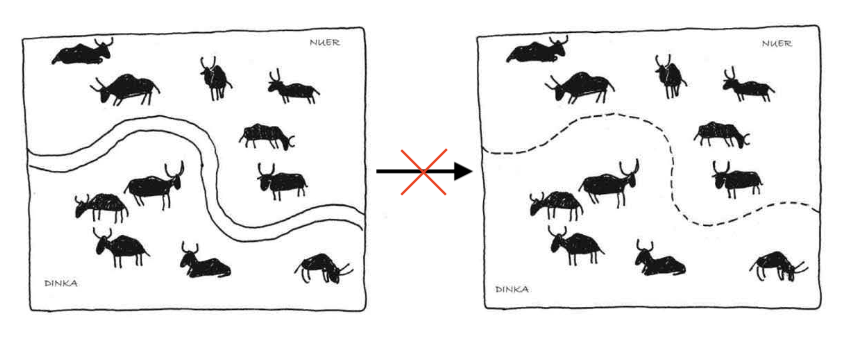
- Что должно быть объясняемым (explanandum)? Возникновение и устойчивость принудительной социальной структуры (например, границы, права собственности).
- Что Гуала использует как объясняющее (explanans)? Уже существующую, работающую социальную структуру (конвенцию о разделе по реке), которую он встраивает в начальные условия своей модели.
- Итог: Он строит теорию, где институт (как готовая конвенция) является предпосылкой для объяснения института (как устойчивого равновесия). Это логический круг (petitio principii). Он объясняет институт через самого себя. Это фатально, потому что весь пафос Гуалы — показать, как правила и равновесия совместно порождают институты. Но в его ключевом примере правило («паси на своей стороне») не порождается игрой — .оно дано ей изначально как часть истории
- Вывод 1: Гуала не моделирует возникновение института. Он моделирует воспроизводство уже существующего института в слегка изменившихся условиях (река исчезла, но «правило» осталось). Его модель объясняет не «почему есть граница», а «почему сохраняется инерция уже существующей конвенции о границе, если физический маркер исчез». Это другая, более простая проблема.
- Если рассмортреть пример Гуалы с выпасом скота как настоящую ЯГБ (без предустановленной конвенции в виде реки как границы), то там будет и равновесие, и правило — но не в онтологическом смысле уже существующей конвенции, а как условная стратегия.
- Вывод 2: Это ставит под вопрос необходимость правил для определения института. Возможно, правила не необходимы.
2.2. Неустойчивость коррелированного равновесия: правило без санкции в условиях неполной информации
- Рассматривается реалистичная игра ЯГБ без предустановленной конвенции в качестве равновесия
- Находится байесовское равновесие в этой игре с неполной информацией.
- Показывается, что оно отличается от коррелированного равновесия, и что стратегия «всегда посылать сигнал “Владелец” и играть по правилу Буржуа-стратегии» строго выгоднее, чем простая условная стратегия Буржуа.
- Делается вывод, что КР недостаточно для описания института.
Центральный тезис Гуалы — что КР адекватно описывает устойчивость института. Однако это не так, поскольку работает только в случае допущения о полной информации в игре. Чтобы это показать, представляем игры в развернутой форме и находим байесовское равновесие.
Стратегия Буржуа в ЯГБ является КР в игре с полной информацией — если типы игроков наблюдаемы обоими игроками. Чтобы это показать, введём понятия истории игры и информационного множества.
История \(h \in H\) — конечная последовательность ходов (или узлов дерева) игры в развёрнутой форме \(h = (a_1, a_2,\dots, a_k)\). Информационное множество \(I_R\) — это набор неразличимых для получателя историй игры. Если \(|I_R| > 1\), то получатель не знает, в каком узле игры он находится, что усложняет принятие решения. В ЯГБ в примере Гуалы с животными: \[ \begin{gathered} h_1 = \{\theta_1, m_1\} \\ h_2 = \{\theta_2, m_2\} \\ I_R = \{h\} \end{gathered} \] Поскольку \(I_R = 1\) (истории эквивалентны, так как идентичны по форме), получатель сигнала точно знает, в каком узле игры находится.
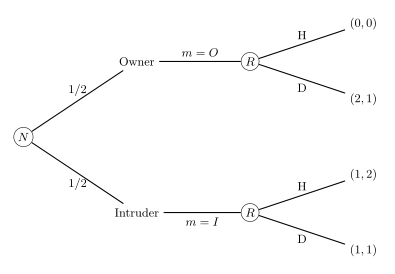
А в примере Гуалы с племенами: \[I_R(m_1) = \{h, (\theta_2, m_1)\}\]
Тип отправителя неразличим для получателя сигнала — он видит один и тот же сигнал «я владелец» и когда отправитель действительно «владелец», и когда он «чужак», что обозначено на схеме пунктирной линией. Это создаёт неопределённость и лазейку для эксплуатации получателя.
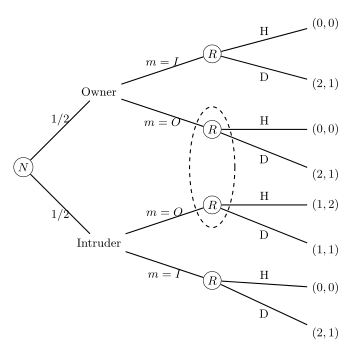
Поскольку получатель не может различить, в каком узле игры находится и кто его оппонент по реальному типу, отправитель сигнала может всегда посылать сигнал «я — владелец», даже не являясь им фактически.
Введём новую стратегию «Блефующий» и рассчитаем средние платежи согласно стандартным условиям игры «Ястреб-Голубь», где стоимость конфликта выше ценности ресурса \(C > V\), и каждый игрок может быть либо захватчиком, либо владельцем (Maynard Smith, 1982):
- Буржуа (B) — честная стратегия:
- Сигналит свой истинный тип.
- На сигнал «владелец» → Голубь.
- На сигнал «захватчик» → Ястреб.
- Блефующий — обманывающая стратегия:
- Всегда сигналит «владелец».
- На сигнал «владелец» → Голубь.
- На сигнал «захватчик» → Ястреб.
Встреча M vs B:
| M тип | B тип | Сигналы | Действия | Платёж M |
|---|---|---|---|---|
| Владелец | Захватчик | (Владелец, Захватчик) | Ястреб, Голубь | V |
| Захватчик | Владелец | (Владелец, Владелец) | Голубь, Голубь | V/2 |
Встреча B vs. B
| B тип | B тип | Сигналы | Действия | Платёж M |
|---|---|---|---|---|
| Владелец | Захватчик | (Владелец, Захватчик) | Голубь, Голубь | V/2 |
| Захватчик | Владелец | (Захватчик, Владелец) | Голубь, Голубь | V/2 |
Средний платёж M: \[ EU(M,B) = \frac12 \cdot \frac{V}{2} + \frac12 \cdot V = \frac{3V}{4} \]
Выигрыш «Блефующего» строго больше выигрыша Буржуа: \(\frac{3V}{4} > \frac{V}{2}\) при \(C > V\) (и, следовательно, \(V - C < 0\)).
- следование правилу (то есть условной стратегии Буржуа в КР) — не лучший ответ. Вместо этого можно сблефовать и получить больший выигрыш
- чтобы условная стратегия стала КР, нужен модификатор платежа для стратегии блефа: Гуала его либо уже предполагает встроенным в игру (делая институт черным ящиком), либо игнорирует:
\[\frac{3V}{4} - \delta \geq \frac{V}{2} \]
Это означает, что санкция за блеф \(\delta\) должна превышать ожидаемую выгоду от блефа, равную \(\frac{V}{4}\). Значит, институт может быть устойчивым даже при малых санкциях, однако КР все равно этого не объясняет.
- Вывод: концепция коррелированного равновесия недостаточна для описания устойчивости института — для нее принципиальна защита от блефа при неполной информации. КР схватывает лишь финальное состояние работающего института в игре с полной информацией. Поэтому нужна нужна динамическая устойчивость равновесия, которая может объяснить, как стратегия может возникнуть и закрепиться через динамический процесс (обучение, имитация, эволюционный отбор).
- Институт в человеческом обществе не может быть смоделирован как коррелированное равновесие в игре с объективными, проверяемыми сигналами (как у Гуалы). Реальный институт — это попытка установить что-то вроде КР в игре со стратегическими, ненадёжными сигналами.
Общий вывод: Теория «правил-в-равновесии» не выполняет своей основной задачи — объяснить принудительную силу институтов. Она либо тавтологична, либо описывает невозможный объект.
Вывод главы: необходимость динамической онтологии, исходящей из до-институционального состояния и не предполагающая существования готовой конвенции, которая интегрирует и равновесия, и правила в смысле Сёрла.
Глава 3. Формальные условия устойчивости института: локальная компенсация блефа и взаимная информация между стратегическими ситуациями
В этой главе мы строим формальную модель игры ЯГБ с неполной информацией и показываем условия динамической (эволюционной) стабильности условной стратегии.
3.1. \(\delta\)-параметр как необходимое условие локальной устойчивости
- Поскольку оригинальная игра ЯГБ уже включает в себя термины «захватчик» и «владелец», которые можно трактовать институционально — как наличие или отсутствие уже закрепленного права собственности, мы начнем с симметричной игры Ястреб-Голубь
- Опираясь на эволюционную динамику Скирмса, мы говорим, что условная Буржуа-стратегия, зависимая от информационной асимметрии (сигнала) появляется в игре как результат адаптации в популяции, даже если агенты не обладают понятием собственности.
- Это позволяет получить понятие коррелированной конвенции. Однако она, как мы показали в прошлой главе, предполагает полноту информации.
- Если убрать полноту информации, Буржуа-стратегия перестанет быть ЭСС
- Так же, как и в главе 2 с КР, здесь возникает необходимость компенсации блефа — дельта-параметр
- Это позволяет нам сказать, что устойчивость института не зависит от конкретного равновесия — и ЭСС, и КР в ЯГБ рушатся при неполной информации. Значит, сущность института — не в равновесии.
Чтобы показать, что стратегия \(B\) (Буржуа с неполной информацией) не является ЭСС, достаточно показать, что существует мутант, у которого платёж против Буржуа выше, чем у Буржуа против себя:
\[\exists\ M : \quad \pi(M,B) > \pi(B,B)\]
Буржуа не различает тип соперника, поэтому платёж стандартный: \[ \pi(B,B) = \frac{V}{2} \] * Владелец получает V с вероятностью ¹⁄₂ * Захватчик получает 0 с вероятностью ¹⁄₂
Берём «блефера», который использует неполную информацию о сигнале:
- Всегда сигнализирует «я — владелец»
- В остальном играет по правилу Буржуа: Голубь на сигнал владельца, Ястреб на сигнал захватчика
\[EU(M,B) = \frac12 \cdot \frac{V}{2} + \frac12 \cdot V = \frac{3V}{4}\]
Выигрыш «Блефующего» строго больше выигрыша Буржуа: \(\frac{3V}{4} > \frac{V}{2}\) при \(C > V\) (и, следовательно, \(V - C < 0\)).
Стратегия Буржуа с неполной информацией не является эволюционно устойчивой, поскольку существует мутантная стратегия, избегающая конфликтов и забираюшая ресурс за счет блефа.
Это означает, что условная стратегия сама по себе не может быть эволюционно стабильной: корреляции стратегий недостаточно для стабильных социальных контрактов — вероятность блефа модифицирует платежи и нарушает равновесие.
Восстановление стабильности требует поддерживающего механизма. Для Гуалы подобный механизм — репрезентация агентом равновесия с помощью регулятивного правила: она мотивирует агента выбрать коррелированную стратегию.
Восстановление эволюционной стабильности условной стратегии возможно благодаря введению параметра, который бы выравнивал платежи стратегий Буржуа и Блефующего:
\[\pi(M, B) - \delta < \pi(B, B)\]
Подобный дельта-параметр можно вывести, определив платежи стратегий Буржуа и блефующего чужака.
Вычтем из выплаты блефующего чужака штраф \(\delta\), применяемый к факту эксплуатации неопределенности, а не к самому конфликту: \[ \pi_{M}^\delta=V-\delta \]
Это означает, что эволюционно стабильное равновесие в условных стратегиях не может существовать в среде с ненулевой вероятностью блефа без модификатора платежей. Введение \(\delta\) делает стратегию Буржуа устойчивой на уровне платежа.
Получаем минимальный модификатор платежа, необходимый для поддержания «очевидности» коррелированной (условной и симметричной) стратегии Буржуа для агента:
\[\delta_{\min }={V}{4}\]
Таким образом, \(\delta\)-параметр — это структурная необходимость для восстановления эволюционной стабильности равновесия в условных стратегиях в ситуации неполной информации — возможности несоответствия сигнала типу игрока-отправителя. Этот параметр восстанавливает стабильность за счёт введения стоимости, независимой от реализации конфликта.3.2. Проблема масштаба: от одной игры к популяции. Параметр \(r\) и надёжность компенсации блефа
- Если положить не одну игру, а несколько идентичных игр, в каждой из которых санкция не гарантирована, то дельты (и ее размера) становится недостаточно
- Если в каждой игре дельта либо применена, либо нет (что выражено бинарной случайной величиной E), то эффективная дельта во всех играх будет \(\delta \cdot \r\), где \(r\) — эмпирическая частота реализации дельты в игре (санкция применена)
- Это позволяет показать, что при низкой надежности компенсации блефа \(r\) во популяции игр Буржуа-стратегия не может быть глобальной ЭСС → равновесие разрушается
Как мы показали в прошлой главе, репрезентация равновесия агентом с помощью регулятивного правила не необходима для поддержания стабильности института. Вместо этого санкция восстанавливает эволюционную стабильность коррелированного равновесия с помощью модификации платежей.
В этой главе я показываю, что институт с модификатором платежа \(\delta\) стабилен только локально, в одной игре, но рушится при наличии множества игр. Это позволит формально отделить институт от протоинститута.
Локальная ESS означает устойчивость стратегии в одной игре \(𝐺_i\). Глобальная устойчивость — в популяции, где много экземпляров игры \(G_N\) происходят в разных местах и моментах. Это пространственная множественность или временная повторяемость:
\[\mathcal{G} = \{G_1, G_2,…,G_N\}\]
Важно, что хотя \(\delta\) — объективный параметр института, его применение в каждой конкретной игре не гарантировано. Санкция может не реализоваться, что аннулирует дисконтирование платежа нарушителя, и он получит платёж \(V\) вместо \(V - \delta\).
Бинарная случайная величина \(E ∈ \{0, 1\}\) определяет, применена ли санкция в конкретной игре: \(1\) означает, что санкция \(\delta\) применена, а \(0\) — не применена. Платежи в локальной игре содержат скрытый параметр \(r \coloneq P(E = 1)\) — объективную вероятность применения санкции. Она означает надёжность механизма принуждения (enforcement), а при рассмотрении популяции игр — частоту реализации санкции в популяции игр. Поскольку в одной локальной игре применение санкции гарантировано (по результатам прошлой главы), то \(r = 1\), поэтому этот параметр скрыт. Однако для популяции игр эффективная санкция будет:
\[\delta_{eff} = 1 \times \delta\]
В популяции игр \(r\) — эмпирическая частота реализации санкции:
\[r = \frac{1}{N} \sum^N_{i=1}E_i\]
Например, есть 5 игр, в трёх из которых санкция была применена: \(E = \{0, 1, 1, 0, 1\}\). Тогда \(r\) по ним будет \(\frac{3}{5} = 0.6\), а эффективная санкция \(\delta_{eff} = 0.6\delta\).
Для глобальной стабильности \((B, B)\) средняя эффективная санкция должна быть выше минимально допустимой:
\[\delta_{eff} = r\delta \geq \delta_{min}\]
Иначе говоря, минимальная частота реализации санкции в популяции игр должна быть:
\[r_{min} = \frac{1}{N} \sum^N_{i=1}E_i = \frac{\delta_{min}}{\delta}\]
Это значение можно назвать порогом институциональности поведенческого паттерна: ниже этого значения применение санкций станет непредсказуемым и институт станет протоинститутом.
3.3. Взаимная информация \(I\) о компенсации блефа как мера связности идентичных стратегических ситуаций
- Для поддержания Буржуа-стратегии как глобальной ЭСС нужен механизм или устройство для повышения надёжности санкции \(r\)
- Функция этого механизма — повышение статистической связности (корреляции) или взаимной информации между фактами применения дельты в каждой из игр. Иначе говоря, нужен канал информации между играми, делающий применение санкции после нарушения предсказуемым.
- Подобный механизм и составляет глубинную онтологическую основу институа.
Повышение надежности санкции (то есть частоты ее применения в играх популяции) требует механизма повышения связности между играми — статистической зависимости фактов реализации санкции. Это можно выразить как снижение дисперсии \(D(r)\), энтропии доставки санкции \(H(r)\) или повышение взаимной информации между двумя случайными играми \(I(E_i, E_j) > 0\). Подобный механизм выравнивает среднее значение санкции \(\delta_{eff}\) в популяции игр.
Иначе говоря, для восстановления глобального равновесия, необходимо, чтобы реализация санкции а одной игре была информативной относительно других и была предсказуемой на уровне системы.
Подобный механизм и составляет глубинную онтологическую основу институа.
Статистическая связь между реализациями санкций в играх популяции — это структура информационного канала между играми, а не модификация платежа или отдельная сущность.
3.4. Формальное определение: институт, протоинститут, конвенция
- Формально, институт в нашей концепции — это сеть дельта-стабилизированных равновесий в условных стратегиях с высокой взаимной информацией.
- Прото-институт (как часть определения института) —
.это равновесие в условных стратегиях (неважно,
коррелированное, байесовское, ЭСС) в расширенной игре с неполной
информацией и конфликтом интересов, которое является
Парето-улучшением по отношению к существующему равновесию в
базовой (не расширенной) игре
- Эквивалентная ситуация — множество игр с таким равновесием, но с низкой взаимной информацией: применение санкции в одной ситуации ничего не говорит об ее применении в другой.
- для существования института нужны:
- ситуация с конфликтом интересов (описываемые играми ЯГБ, дилемма заключенного, битва полов)
- условная стратегия, решающая конфликт и связанная с чистыми стратегиями (а не как у Гуалы)
- \(\delta\)-параметр — модификатор платежа для стратегии, эксплуатирующей условную стратегию
- равновесие в условных стратегиях (неважно, какое)
- множество структурно идентичных игровых ситуаций с равновесием и дельтой
- любой механизм или устройство, повышающий взаимную информацию (или статистическую корреляцию) о применении санкции между игровыми ситуациями
Глава 4. Каузально-информационная онтология института: связная сеть \(\delta\)-стабилизированных равновесий в условных стратегиях
В главе говорится:
- Институт — это набор механизмов, глобально наказывающих эксплуатацию условной стратегии в определенном классе стратегических ситуаций.
- Институт решает две информационных проблемы: компенсация стратегической эксплуатации и масштабирование применения компенсации. Можно объединить в одну задачу — глобальная компенсация стратегической эксплуатации
- Масштабирование существующей санкции — онтологическая суть института. Равновесия с санкцией недостаточно для существования института (это протоинститут).
- Если санкция для компенсации блефа необходима эволюционно в
ситуации неполной информации, то масштабирование этой санкции —
нет.
- Это означает, что в него инвестируют те, кто хотят обладать монополией на дельту (это дает критический угол нашей теории, позволяя смотреть на источники статистической связности санкций)
- И правила, и равновесия не являются онтологически фундаментальными для определения института. Вместо этого, санкция за отклонение от условной стратегии и канал доставки этой санкции между играми — онтологически фундаментальны.
- Правила — удобный язык для описания состояния параметров \(\delta\) и \(I\) в обпределенной сети
стратегических ситуаций, а не онтологически фундаментальный слой
реальности. Однако они полезны как эпистемический «плагин» для
описания
- Конститутивное и регулятивное правило действительно идентичны по форме (как предполагает Гуала), но первое несводимо ко второму. Конститутивное правило — это та же самая условная стратегия в игре с конфликтом интересов и неполной информацией, только ставшая общим знанием в сети игр благодаря высоко взаимной информации \(I\) о применении санкции: «Я знаю, что все знают, что если пришел первым на холм, то можешь пасти стадо, иначе последует рейд от другого племени».
- При достижении высокой взаимной информации о применении санкции между игровыми ситуациями санкция обретает новый смысл — она теперь не за блеф в локальной стратегической ситуации, а за игнорирование общего знания о применении санкции. Это согласуется с идеей Сёрла о деонтических силах конститутивного правила, не противоречит формальной логике нашей модели и реализует интуицию Гуалы о близкой связи конститутивных и регулятивных правил
4.1 Институт и протоинститут: значение параметров \(\delta\) и \(I\)
- Масштабирование существующей санкции — онтологическая суть института.
- Если санкция для компенсации блефа необходима эволюционно в
ситуации неполной информации, то масштабирование этой санкции —
нет.
- Это означает, что в него инвестируют те, кто хотят обладать монополией на дельту (это дает критический угол нашей теории, позволяя эмпирически смотреть на источники статистической связности санкций в конкретном классе ситуаций)
- Если каналы доставки и масштабирования санкции — суть
института, то они должны быть до-институциональными. Они
онтологически примитивны и выполняют одну или несколько функций:
- Социальная память и репутация («В этом племени все знаютб что Х — обманщик»)
- Физическая связанность территории (возможность быстро дойти до нарушителя)
- Наблюдаемость действий (открытая местность, где всё видно)
- Любой механизм или устройство, обеспечивающие одну или больше
функций (память, физическая доступность, наблюдаемость), может
служить эмпирическим каналом «доставки» санкции.
- Каналы доставки санкции являются интерсубъективно
интерпретируемыми материальными носителями или социальными
технологиями (все знают, что они кодируют дельту):
- Физические артефакты: дорожные знаки, униформа, печати, камеры, стены, оружие.
- Социальные технологии: ритуалы, процедуры, публичные казни, формализованные речи (клятвы, приговоры).
- Символические системы: письменные кодексы, базы данных, репутационные рейтинги.
- Каналы доставки санкции являются интерсубъективно
интерпретируемыми материальными носителями или социальными
технологиями (все знают, что они кодируют дельту):
- При этом, и за локальную дельту, и за каналы доставки дельты можно конкурировать. Это позволяет объяснить многие феномены от клановых войн (борьба конкретных локальных дельт) до политической борьбы (борьба за право насаждать одну дельту глобально)
4.2 Статус равновесий
Равновесия необходимы, но недостаточны для определения института:
- равновесие действительно отражает стабильное состояние социальной системы, однако для института оно невозможно без модификатора платежа — вне зависимости от типа устойчивости (ЭСС, КР)
- это означает, что равновесие не схватывает сущность института само по себе
- вместо этого, санкция, компенсирующая блеф схватывает суть института
- однако даже дельты недостаточно самой по себе, поскольку она решает конфликт локально, и нужна корреляция не только стратегий внутри игры, но и корреляция применения санкций между играми
- 🔥 интуиция института как корреляции стратегии, встречаемая в литературе (Gintis, 2009b; Guala & Hindriks, 2015; Vanderschraaf, 2017), верна, но неточна — институт требует не только скоррелированных стратегий, но и скоррелированных фактов наказания за отклонения от этих скоррелированных стратегий, иначе это просто конвенция, а не институт.
4.3 Статус правил
- Правила не имеют собтвенной онтологии в нашей концепции, но
могут служить удобными интерфейсами к этапам развития сети,
определяемыми значением параметров \(\delta\) и \(I\):
- Условная стратегия в игре с конфликтом за ресурс может быть описана как регулятивное правило «если…, то…», которое агент использует как рецепт действия — так, как предполагает Гуала. Однако это не добавляет ничего в онтологию — это просто условная стратегия
- Конститутивное и регулятивное правило действительно идентичны по форме (как предполагает Гуала), но первое несводимо ко второму. Конститутивное правило — это та же самая условная стратегия в игре с конфликтом за ресурс, только ставшая общим знанием в сети игр благодаря высоко взаимной информации \(I\) о применении санкции: «Я знаю, что все знают, что если пришел первым на холм, то можешь пасти стадо, иначе последует рейд от другого племени».
- При достижении высокой взаимной информации о применении санкции между игровыми ситуациями санкция обретает новый смысл — она теперь не за блеф в локальной стратегической ситуации, а за игнорирование общего знания о применении санкции. Это согласуется с идеей Сёрла о деонтических силах конститутивного правила.
- Это объясняет эмердженцию автономного социального порядка без магии, как это есть у Серла или Дюркгейма в социологии
- Если сеть игр — онтологический «бэкенд» института, то правила с их различением конститутивных и регулятивных — пользовательский интерфейс, делающий описание более удобным и в терминах агентов, и в терминах внешнего наблюдателя.
- Правила — эпистемическия «плагин» для удобства описания онтологии, а не онтологический примитив, как полагал Сёрль. Однако это не умаляет важность его интуиции.
5. Заключение: параметрическая социальная онтология и новая исследовательская программа
5.1. Диагностика тупика: почему «правила-в-равновесии» не решают проблему принудительной силы
- Краткий итог критики Гуалы: Теория Гуалы страдает не просто логическим кругом, а онтологической статичностью. Она принимает как данность то, что требует объяснения — готовую конвенцию («паси на своей стороне реки»), и описывает не генезис института, а его инерционное воспроизводство. Это следствие реифицирующей онтологии, где правило и равновесие — готовые сущности.
- Ключевой пробел: Игнорирование проблемы неполной информации (блефа) и, что критически важно, проблемы масштабирования локальной стабильности на множество взаимодействий. Его коррелированное равновесие (КР) — это описание состояния системы, а не механизм её устойчивости в реалистичных условиях.
5.2. Предложенное решение: параметрическая социальная онтология \(\delta/I\)-сетей и её фундаментальные параметры
- Смена онтологической оптики: Вместо сущностей (правила,
равновесия) предлагается каркас, основанный на динамических
параметрах, описывающих условия устойчивости.
- Параметр \(\delta\): Решает локальную проблему блефа. Это необходимое условие устойчивости любого равновесия (будь то ЭСС или КР) в единичной игре с конфликтом и неполной информацией. Он вводит в онтологию силовой/санкционный компонент как фундаментальный.
- Параметр \(I\) (взаимная
информация): Решает глобальную проблему масштаба. Он фиксирует
неопределенность (\(r\))
применения санкции \(\delta\) в
популяции игр. Высокое
Iозначает наличие каналов, делающих применение санкции предсказуемым и связным в разных ситуациях. Это вводит в онтологию информационно-сетевой компонент как фундаментальный.
- Новые определения как следствие:
- Протоинститут: Устойчивое равновесие, обеспеченное \(\delta\) в локальной игре
(
Iнизко или нерелевантно). - Институт (в строгом смысле): Связная сеть \(\delta\)-стабилизированных
равновесий, характеризуемая высоким значением
Iмежду её узлами (стратегическими ситуациями). Институт — это не вещь, а паттерн связности в пространстве параметров \(\delta\) иI.
- Протоинститут: Устойчивое равновесие, обеспеченное \(\delta\) в локальной игре
(
5.3. Методологическая рефлексия: статус теории и её позиция в философии науки
- Реализм без реификации (Структурный реализм): Теория не
является инструменталистской. Параметры \(\delta\) и
Iописывают объективные, каузально действующие структуры (паттерны связности и силы), необходимые для объяснения наблюдаемой устойчивости социальных порядков. Реальны не правила, а эти лежащие в их основе каузально-информационные паттерны (Dennett, 1991; Ladyman, Ross, Spurrett, & Collier, 2007). - Объяснение через лучшее объяснение (IBE, inference to the best
explanation): Вся конструкция является выводом к наилучшему
объяснению (IBE). Объясняется устойчивость сложных форм
координации вопреки неопределенности и оппортунизму за счет
существования сетей с высокими \(\delta\) и
I. Это объяснение лучше альтернатив (Сёрл, Гуала), так как оно:
- Ненадуманно (non-ad hoc): параметры \(\delta\) и
Iвводятся как решение четко формализованных проблем (блеф, масштаб). - Объединяюще (unificatory): охватывает и «деонтическую силу»
(через предсказуемость санкции при высоком
I), и «устойчивость равновесия» (через \(\delta\)). - Эмпирически ориентированно: задает новые единицы анализа
(\(\delta\),
I, сетевые каналы).
5.4. Продуктивность теории \(\delta/I\)-сетей как исследовательской программы: обратная совместимость с эмпирикой
- Операционализация понятий: главное методологическое новшество
— перевод философской онтологии в потенциально измеримые концепты.
\(\delta\) может быть
операционализирован как издержки/риски нарушения (от штрафов до
потери репутации).
Iможет быть операционализирован через сетевой анализ каналов коммуникации, мониторинга и принуждения (от скорости распространения сплетен до плотности CCTV). - Сдвиг фокуса для эмпирических исследований: Теория предлагает социологам искать не «правила» или «нормы», а:
- Источники \(\delta\): Кто/что и как может накладывать издержки?
- Каналы, повышающие
I: Как информация о применении \(\delta\) передается между ситуациями? (Социальные сети, СМИ, судебная система, ритуалы). - Точки разрыва сетей: Где
Iпадает, превращая институт в кластер нестабильных протоинститутов?
5.5. Ограничения и направления дальнейшего развития
Теория объясняет условия устойчивости принудительного социального порядка, а не его конкретное символическое содержание, смыслы или историческую траекторию. Это .онтологический и методологический каркас, а не полная социальная метафизика
Направления развития:
- Математическое: Уточнение моделей перехода от
Iкr(надежности). - Алгоритмическое: использование теории для решения насущных проблем обучения с подкреплением в мультиагентных системах
- Эмпирическое: Разработка методов измерения \(\delta\) и
Iв конкретных кейсах (например, сравнительный анализ институтов в онлайн-сообществах vs. традиционных обществах). - Теоретическое: Интеграция с концепциями легитимности (как фактор, снижающий требуемый порог \(\delta\)) и изучение динамики конкуренции за контроль над сетевыми узлами.
Представленная теория совершает тройной вклад:
- В социальную онтологию — она преодолевает тупик
синтеза через переход от онтологии реифицированных сущностей
(правила, равновесия) к онтологии фундаментальных
каузально-информационных параметров (\(\delta\),
I). - В методологию социальных наук — она предлагает не просто новую интерпретацию институтов, а новый, потенциально операционализируемый концептуальный каркас, который переводит философские вопросы о природе социального порядка в плоскость конкретных исследовательских программ, фокусирующихся на силе, информации и сетевой связности.
- В исследования мультиагентных систем — она может быть апробирована для решения дилеммы блефа в проблемах обучения с подкреплением
phd
Источники
Однако эта принудительная сила не является надындивидуальной, как у Дюркгейма (Durkheim, 2014), определившего социальные факты как способы действия, мышления и чувствования, обладающие принудительной силой. Для Сёрла нет надындивидуальной социальной реальности за пределами коллективного признания.↩︎
Коррелированное равновесие — концепция решения из теории игр, обобщающая равновесие Нэша, когда все игроки получают личный сигнал от третьей стороны, и в их интересах следовать этому сигналу (Aumann, 1987). Ярким примером является светофор. Гуала и другие учёные утверждают, что социальные нормы и правила являются такими корреляционными механизмами, подобными светофорам.↩︎
Это «гомеостатические кластеры свойств» (Boyd, 1991), которые поддерживают индуктивное обобщение и научный вывод.↩︎
This distinction mirrors the classic one of natural and social kinds, where the former are “homeostatic property clusters”, sets of necessary and stable features (Boyd, 1991).↩︎
As Hume (1998) writes, “It has been asserted by some, that justice arises from human conventions, and proceeds from the voluntary choice, consent, or combination of mankind … if by convention be meant a sense of common interest; which sense each man feels in his own breast, which he remarks in his fellows, and which carries him, in concurrence with others, into a general plan or system of actions, which tends to public utility; it must be owned, that, in this sense, justice arises from human conventions. For if it be allowed (what is, indeed, evident) that the particular consequences of a particular act of justice may be hurtful to the public as well as to individuals; it follows, that every man, in embracing that virtue, must have an eye to the whole plan or system, and must expect the concurrence of his fellows in the same conduct and behaviour. Did all his views terminate in the consequences of each act of his own, his benevolence and humanity, as well as his self-love, might often prescribe to him measures of conduct very different from those, which are agreeable to the strict rules of right and justice …”. Schliesser (2024) notes that positive social externality is a requirement for a purely “Humean” convention.↩︎
A payoff matrix is a mathematical representation that shows the possible outcomes for each combination of strategies chosen by the players. Achieving coordination often requires stabilizing communication to arrive at mutual agreement, especially when different individuals or groups have conflicting preferences. This need for a reliable mechanism to resolve coordination issues is crucial in many social contexts.↩︎
Epistemic game theorists contend that there is no correlate of mixed-strategy equilibrium when viewed from epistemic (or knowledge) point of view (Perea, n.d.). I agree with them and only talk about it here for the purposes of comparison with CE.↩︎
On a planet identical to Earth in almost all respects but featuring water composed of XYZ rather than H₂O, inhabitants use the term “water” yet refer to different substance. According to Putnam, this illustrates that psychological states alone do not determine meaning; external factors like chemical composition and environmental acquisition influence linguistic reference. His assertion is encapsulated by his famous statement: “meanings just ain’t in the head”. This will be crucially important for us later in the discussion of the problem of ontic reference within the study of evolution of social conventions.↩︎
The emergence of objective yet relative moral norms in accordance with Lewisian approach and rigor was developed by (mackenzie2007?), which echoes “arbitrary yet stable” notion of instrumental conventions.↩︎
As Skyrms has shown (2010a, 2010b), the pattern can be learned dynamically in iterated games: both X and Y can be established and recognized with trial-and-error via reinforcement learning.↩︎
The Dirichlet rule is a Bayesian updating procedure based on the Dirichlet distribution used for modeling probabilities over a finite set of discrete outcomes (“a distribution over distributions”). In learning models, the Dirichlet rule updates the probability assigned to each probability distribution by counting the number of times each of them has produced a particular outcome such as a reward. These counts serve as parameters of the Dirichlet distribution, which then yields a probability distribution over the options. Formally, if option \(j\) has been rewarded \(\gamma_j\) times, the updated probability for option \(j\) is proportional to \(\gamma_j\), and the probability vector \(\mathbf{x} = (x_1, ..., x_k)\) over \(k\) options is such that \(x_j \in (0,1)\) and \(\sum_{j=1}^k x_j = 1\). This rule captures how empirical frequencies shape probabilistic beliefs in a principled Bayesian manner.↩︎
The distinction between “exogenous” and “endogenous” information influencing agent’s strategy choice is already in Aumann (1987). The former type of information is obtained from external cues and the latter from agents’ reasoning about about how other agents reason. Aumann did not consider the distinction important, for the knowledge of exogeneity/endogeneity of agents’ information or even actions does not contribute to achieving CE. Vanderchraaf’s usage of Dirichlet dynamics clarified how endogeneity can contribute but did not eliminate the external signal altogether.↩︎
Many scholars use metaphors emphasizing the external character of CE: “mediator” and “correlation device” (fudenberg1991?), “choreographer” (Gintis, 2009b) and others.↩︎
Pareto efficiency describes a state where no further improvements are possible for well-being of any individual without simultaneously decreasing the well-being of at least one other individual.↩︎
Ironically enough, O’Connor (2019) uses similar ideas to study the emergence of injustice and maintains that unjust arrangements amplify over time.↩︎
Random matching is a standard assumption in evolutionary game theory where individuals in a large, well-mixed population are paired to interact purely by chance, meaning each individual is equally likely to meet any other, regardless of their strategy. This context is important because, under random matching, the ESS depends solely on the average payoffs determined by the overall population frequencies, and strategies like cooperation typically cannot persist unless they are directly favored by the payoff structure. Deviations from random matching (assortative or structured matching) can introduce correlations between strategies, fundamentally altering which behaviors can be evolutionarily stable (Izquierdo, Izquierdo, & Hauert, 2024; Jensen & Rigos, 2018).↩︎
The Dirichlet rule is a Bayesian updating procedure based on the Dirichlet distribution used for modeling probabilities over a finite set of discrete outcomes (“a distribution over distributions”). In learning models, the Dirichlet rule updates the probability assigned to each probability distribution by counting the number of times each of them has produced a particular outcome such as a reward. These counts serve as parameters of the Dirichlet distribution, which then yields a probability distribution over the options. Formally, if option \(j\) has been rewarded \(\gamma_j\) times, the updated probability for option \(j\) is proportional to \(\gamma_j\), and the probability vector \(\mathbf{x} = (x_1, ..., x_k)\) over \(k\) options is such that \(x_j \in (0,1)\) and \(\sum_{j=1}^k x_j = 1\). This rule captures how empirical frequencies shape probabilistic beliefs in a principled Bayesian manner.↩︎
The distinction between “exogenous” and “endogenous” information influencing agent’s strategy choice is already in Aumann (1987). The former type of information is obtained from external cues and the latter from agents’ reasoning about about how other agents reason. Aumann did not consider the distinction important, for the knowledge of exogeneity/endogeneity of agents’ information or even actions does not contribute to achieving CE. Vanderchraaf’s usage of Dirichlet dynamics clarified how endogeneity can contribute but did not eliminate the external signal altogether.↩︎
Many scholars use metaphors emphasizing the external character of CE: “mediator” and “correlation device” (fudenberg1991?), “choreographer” (Gintis, 2009b) and others.↩︎
Pareto efficiency describes a state where no further improvements are possible for well-being of any individual without simultaneously decreasing the well-being of at least one other individual.↩︎
Ironically enough, O’Connor (2019) uses similar ideas to study the emergence of injustice and maintains that unjust arrangements amplify over time.↩︎
Random matching is a standard assumption in evolutionary game theory where individuals in a large, well-mixed population are paired to interact purely by chance, meaning each individual is equally likely to meet any other, regardless of their strategy. This context is important because, under random matching, the ESS depends solely on the average payoffs determined by the overall population frequencies, and strategies like cooperation typically cannot persist unless they are directly favored by the payoff structure. Deviations from random matching (assortative or structured matching) can introduce correlations between strategies, fundamentally altering which behaviors can be evolutionarily stable (Izquierdo et al., 2024; Jensen & Rigos, 2018).↩︎
A quite important clarification here is that to be “on the same page” about the need of common knowledge and the degree of rationality, we need to take into account the stage of a convention in question: is it just forming or is it already stable? It seems intuitive to suggest that earlier rounds of play require more explicit beliefs and cognitive demands than later rounds when strategies become more automatic and probabilities of actions of others are easier to predict. It is less costly to converge on an equilibrium in later rounds of play, so we need to be explicit about the state of play when discussing the need for common knowledge and cognitive demands of conventions.↩︎
Searle makes deontic powers of institutional facts dependent on language. At the same time, evidence from cognitive archaeology suggests that early hominins were able to solve coordination problems without language. Sterelny (2021) argues that social institutions (or the human social contract) conceived as shared, enforceable norms regulating cooperation and reciprocity emerged before the advent of complex language. Archaeologically, early hominins engaged in cooperative foraging and coordinated tool use, such as the collective extraction of high-value resources, indicating mutualistic collaboration and implicit norm enforcement in small mobile bands from around 1.8 million years ago (Sterelny, 2016, 2021). Comparative primate research supports the plausibility of pre-linguistic cooperation and rudimentary norm enforcement, highlighting that great apes exhibit forms of mutualism and social regulation that likely scaffolded early human cooperation (birch2022?). Together, these findings support Sterelny’s model that proto-social contracts rooted in norms, reputation, and coordination were present in pre-linguistic societies, with language later enabling more abstract, scalable, and formalized norms as human social groups expanded. Although Searle did not conceive of institutions as of solutions to coordination problem, this is relevant from a naturalistic social ontology point of view.↩︎
Guala argued elsewhere that Lewisian conventions acquire normativity (or deontic force) in repeated play, so that history of play becomes a focal point for emergence of normaitvity (Guala & Mittone, 2010). This view is dynamic, whereas the view of payoff-modifiers as repressentations of the “built-in” normativity presuppose a static view of institutions. This, along with a couple of other inconsistencies, complicates the explanation of normativity of social institutions with RiE.↩︎